

I’ve been doing SEO for YMYL sectors in Colombia for nearly 20 years, and the legal sector is one of the most interesting because it combines high search intent with a lack of technical understanding among most founding partners. I’ve audited websites for boutique firms with three partners and full-service firms with 80 attorneys, and the problems are almost identical: misconfigured schema, author-generated content with no demonstrable authority, neglected Google Business Profiles, and blogs lacking a topic cluster strategy.
This article is the result of auditing 25 Bogotá-based websites during the first quarter of 2026 using professional tools (Ahrefs, Search Console, Screaming Frog, PageSpeed). I won’t mention the names of the firms audited out of professional respect, but the patterns are universal. If you’d like to apply this analysis to your own law firm, at Webhexup we offer specialized SEO for lawyers throughout Colombia with verifiable results.
The Bogotá
legal market in figures for 2026.
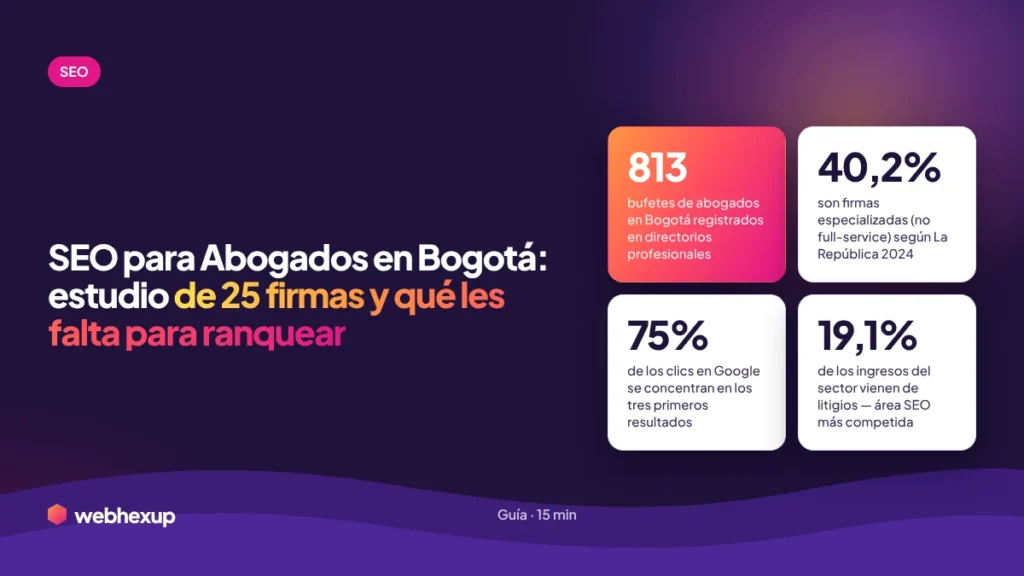
Bogotá accounts for nearly 60% of the Colombian legal sector’s GDP and is where the country’s most significant legal decisions are made. The city is home to the headquarters of Brigard & Urrutia, Posse Herrera Ruiz, Lloreda Camacho, Dentons Cárdenas & Cárdenas, CMS Rodríguez Azuero, Baker McKenzie, Gómez Pinzón-Zuleta, and Philippi Prietocarrizosa Ferrero DU & Uría, among other full-service firms that dominate the rankings. But the majority of Bogotá’s legal market is not made up of these firms: it consists of the 813 boutique, specialized, and single-practitioner firms that compete for every client online.
According to the ranking published by Revista Dinero and the annual survey by Asuntos Legales of 102 Colombian law firms, Brigard & Urrutia leads the sector with $101,974 million in revenue, followed by Philippi Prieto Carrizosa Ferrero DU & Uría with 33.77% growth. But the most interesting data for your boutique firm isn’t the big firms’ numbers—it’s the figures from the segment where you actually compete.
40.2% of Colombian firms are specialized—that is, firms with fewer than 30 attorneys that dominate a specific niche. The areas that generate the most revenue are litigation (19.12%), commercial law (16.91%), mergers and acquisitions, and intellectual property. In SEO, this translates to a very clear competitive landscape: generic keywords like “lawyer Bogotá” are dominated by the large firms, but long-tail, specific keywords like “labor lawyer in Chapinero,” “tax lawyer in Bogotá,” or “family lawyer in Teusaquillo” are within reach for a boutique firm with a solid SEO strategy.
The Selection Criterion That Changes Your SEO Strategy
The Asuntos Legales study revealed something that almost no SEO consultant explains to their legal clients: when a company hires an external consultant, the main selection criterion is the lawyer’s track record (14 votes out of 102), followed by the board of directors’ decision, the firm’s size, membership in international directories, and, lastly, price. This means your website shouldn’t sell price—it should sell verifiable track record and subject-matter authority.
The practical implication for your SEO is clear. Each founding partner needs an author page featuring a detailed biography, representative cases (without violating confidentiality), academic publications, conferences presented, and links to verifiable external profiles such as LinkedIn, Chambers and Partners, legal directories, and participation in professional associations. This isn’t vanity—it’s the technical foundation for Google to recognize your firm as an authoritative entity and rank it among the millions of searches for legal terms in Bogotá each month.
The 7 Most Common
SEO Mistakes at 25 Bogotá Law Firms.
In February and March 2026, we audited the websites of 25 Bogotá-based law firms, divided into three segments: 8 full-service firms with more than 50 attorneys, 12 specialized or boutique firms with 5 to 30 attorneys, and 5 single-practitioner firms. These are the recurring findings:
| SEO Issue Detected | Frequency | Impact on ranking |
|---|---|---|
| No "Person" schema for partners | 23 out of 25 firms | High — they lose EEAT and AI citations |
| Google Business Profile with no recent posts | 21 out of 25 | High — lose Local Pack and Maps |
| No active blog or blog abandoned more than 6 months ago | 18 of 25 | High — no content to rank for long-tail keywords |
| Core Web Vitals with LCP greater than 4 seconds | 16 out of 25 | Medium-high — penalizes mobile experience |
| Practice pages without a primary keyword in the H1 tag | 15 of 25 | Medium — easily fixable basic error |
| No Google reviews or fewer than 10 reviews | 14 of 25 | High — affects trust and conversion |
| Site without a properly configured SSL certificate | 4 out of 25 | Critical — Google penalizes “unsecure” sites |
Issue 1 — The absence of the Person schema undermines authority
Of the 25 firms audited, only two had correctly implemented the Person schema for their founding partners. The other 23 publish photos, biographies, and representative case studies in plain HTML without any structured markup to tell Google, “This is a real lawyer with this verifiable background, author of these articles.” That’s a serious mistake in the YMYL sector.
The Person schema must include name, jobTitle, alumniOf with the alma mater, sameAs linking to LinkedIn and profiles in professional directories, hasCredential with a verifiable professional license where applicable, and memberOf with professional associations such as the Bar Association or the ICDP. Without these attributes, Google’s algorithms and generative AI models cannot distinguish your founding partner with 30 years of experience from a newly graduated lawyer who started a blog last week.
Mistake 2 — Neglected Google Business Profile
84% of the firms audited have a Google Business Profile set up but with no posts in the last three months. Some had responded to only a few reviews, others hadn’t responded to any, and several were still displaying photos of their previous office after moving. This is a huge missed opportunity because the Local Pack and Google Maps are primary lead generation channels for legal services in Bogotá: when someone searches for “labor lawyer Chapinero,” Google first displays the three businesses in the Local Pack and only then shows traditional organic results.
A firm with a well-managed listing can appear in the Local Pack even without ranking on the first organic search results page. The process is simple: update photos every 30 days, post at least two weekly updates on blog articles, resolved cases (without violating confidentiality), or regulatory changes, respond to absolutely every review within 24 hours, and fill out all fields on the form, including hours of operation, practice areas, accessibility attributes, and service area. It’s ongoing work, but the return on every hour invested surpasses that of any other SEO channel. For more details, I recommend our comprehensive guide to Google Business Profile in Colombia.
Mistake 3 — Neglected or Never-Started Blog
Of the 25 firms, 18 had a corporate blog, and all but five had abandoned theirs more than six months ago. The active blogs published generic content such as “Five Reasons to Hire a Lawyer” without focusing on actual keywords or search intent. This is absurd in an industry where your potential clients are looking for specific answers to concrete questions: “how to file a lawsuit for wrongful termination in Colombia in 2026,” “what to do if I’m served with a writ of execution,” “how long does a labor conciliation take in Bogotá.” Each of these questions has a monthly search volume in Bogotá, and almost no boutique firm is targeting them.
EEAT in the legal sector:
why almost no one meets these standards in Bogotá.
EEAT—Experience, Expertise, Authoritativeness, Trustworthiness—is the framework Google uses to evaluate the credibility of YMYL websites. The legal sector is one of the strictest YMYL sectors because poor legal advice can ruin a person’s life. Google knows this and severely penalizes sites that fail to demonstrate genuine credibility.
The problem with EEAT in the legal sector in Bogotá is that most firms think that “having a professional license” is enough to demonstrate authority. It isn’t. EEAT requires four verifiable pillars, and most firms fail on at least two:
Experience — Firsthand experience
It’s not enough to say “20 years of experience.” Google wants to see verifiable representative cases, rulings published in legal databases, documented court hearings, and lectures with available video recordings. Real experience is demonstrated through published material, not through phrases in the “About Us” section.
Expertise — Demonstrated technical knowledge
Verifiable alma mater, graduate degrees, specializations, academic publications in Scielo or university repositories, columns in *Asuntos Legales* or *Ámbito Jurídico*. A firm whose founding partner does not have at least three verifiable external references cannot compete with industry leaders.
Authoritativeness — Industry Authority
Mentions in specialized media, inclusion in Chambers and Partners, Latin Lawyer, The Legal 500, or recognized directories. Organic backlinks from Colombian legal websites. Citations in court rulings or industry association documents. Without verifiable external authority, your firm will always be at a disadvantage.
If you want to delve deeper into how to build real EEAT for your professional website, I recommend you also read our guide on EEAT on Google 2026 for Colombian websites, where we explain each component with concrete examples.
Transactional keywords that actually
generate customers in Bogotá.
Here is the keyword map that best reflects the reality of the Bogotá market. I obtained the data by cross-referencing Google Keyword Planner volumes with my own SERP analysis during the first quarter of 2026:
| Keyword | Approx. Monthly Volume | Difficulty | Recommendation |
|---|---|---|---|
| labor lawyer bogota | 1,300 | High | Target with a dedicated landing page + blog cluster |
| Family lawyer in Bogotá | 1,000 | Sign Up | Cluster on divorce, custody, and probate |
| Criminal defense attorney in Bogotá | 720 | Medium-High | Landing Page by Specialty + Success Stories |
| Tax Lawyer in Bogotá | 390 | Medium | Moderate volume but high average fee |
| Civil lawyer in Bogotá | 590 | Medium-High | Breakdown by practice area (contracts, family law, real estate) |
| Immigration lawyer in Bogotá | 480 | Medium | Growth driven by Venezuelans and digital nomads |
| divorce lawyer in Bogotá | 880 | High | Top intent to hire immediately |
| Business legal consulting in Bogotá | 320 | Medium-High | B2B with high transaction values and relatively low competition |
| Labor lawyer in Chapinero | 90 | Low | Neighborhood quick win — easy to rank |
| Family law attorney in Teusaquillo | 50 | Low | Hyperlocal — extremely high conversion rate |
The strategy that works best in Bogotá is to first target hyperlocal terms by neighborhood (Chapinero, Teusaquillo, Usaquén, Norte, Centro Internacional) where competition is low and conversion rates are extremely high, while building subject authority to gradually move up to the city’s main search terms. A new boutique firm can rank for a specific neighborhood within 90 days and for the city within 8 to 10 months if the strategy is correct.
A legal content
strategy that actually ranks on Google.
The most costly mistake Bogotá law firms make is publishing filler content written by interns without technical supervision from a partner. Google immediately detects when a legal article lacks real depth because it reviews signals such as the correct use of case law, citations to specific rulings, references to articles of the Substantive Labor Code or the Civil Code, links to the Civil Service or to Constitutional Court rulings, and consistency between the stated author and the topics they actually master.
The framework I apply for legal SEO
This is the minimum structure a legal blog post must have to rank and to be cited by generative AI models such as Google AI Overviews:
- Exact search query as the H1 heading—matching the main query your potential client is searching for. Not “Reflections on Unjustified Dismissal” but “How to Sue for Unjustified Dismissal in Colombia in 2026.”
- Direct answer within the first 50 words—an AEO block that Google can extract as a featured snippet. The answer must be specific, not generic.
- Applicable legal framework with exact citations—statutes, relevant court rulings, and current decrees. This demonstrates real expertise.
- Step-by-step procedure—break it down into a maximum of 7 steps with estimated timelines, costs where applicable, and required documents. This is what the AI references.
- Exceptions and special cases—where you demonstrate real experience because only a litigating attorney knows those details.
- HowTo or LegalService schema—structured markup that helps Google understand the nature of the content.
- Author identified with a complete bio—Person schema linking to LinkedIn, business card, and academic specialization.
- FAQ with 5+ real questions — drawn from Search Console and the questions they actually receive in consultations.
The topic cluster: the secret to sustainable legal SEO
A firm that only publishes standalone articles loses out to a firm that builds topic clusters. If your specialty is labor law, don’t publish 30 general articles—publish an in-depth pillar page on “Labor Law in Colombia: Complete Guide 2026” and then 15 specific satellite articles such as “Unjustified Dismissal,” “Workplace Harassment,” “Contract Termination,” “Enhanced Job Security Due to Illness,” and similar topics—all linked to the pillar page and to each other. This cluster architecture signals to Google that your site is the subject authority on labor law in Colombia.
To better understand how content cluster architecture works in YMYL sectors, you can supplement this with our technical SEO guide for professional websites, where we delve into URL structure, breadcrumbs, and information architecture.
Ethical mistakes that result
in penalties for lawyers on Google.
Guaranteeing outcomes in legal cases
The Colombian Code of Professional Conduct for Attorneys prohibits guaranteeing case outcomes. A website that claims, “We win 100% of our cases,” is not only ethically questionable—Google also penalizes this type of copy in YMYL sectors because it considers it misleading.
Publishing Testimonials Without Authorization
Attorney-client privilege applies to client testimonials. If you publish a client’s case without their written authorization, you’re not only violating the Disciplinary Code—the client can sue you for damages, and Google may penalize your site if it receives a report. Always request written authorization.
Fake or Purchased Reviews
Buying reviews or asking employees to give the firm positive ratings is a practice that Google is getting better and better at detecting. The penalty is severe: loss of rankings, suspension of your Google Business Profile, and lasting reputational damage.
Unsupervised AI-generated content
Publishing legal articles written entirely by ChatGPT without supervision by a specialist attorney is dangerous because the content may contain regulatory errors. Google massively demoted sites with AI-generated content that offered no added value in the March 2026 Core Update.
The essentials of SEO for lawyers
in Bogotá, presented clearly.
SEO for lawyers in Bogotá operates in a market of 813 registered law firms, where 40.2% are specialty firms and the rest are full-service or single-practitioner firms. The areas with the highest concentration of searches are labor, family, criminal, and tax law. The largest firms—Brigard & Urrutia, Posse Herrera Ruiz, Lloreda Camacho, Dentons, Baker McKenzie—dominate generic keywords, while hyperlocal terms by neighborhood (Chapinero, Teusaquillo, Usaquén) are within reach for boutique firms.
The 7 most common SEO flaws among Bogotá law firms are: lack of a Person schema for partners (23 out of 25 firms audited), Google Business Profile with no recent posts (21 out of 25), abandoned or nonexistent blog (18 out of 25), Core Web Vitals with LCP exceeding 4 seconds (16 out of 25), practice pages without a keyword in the H1 tag (15 out of 25), few Google reviews (14 out of 25), and SSL issues (4 out of 25). Correcting these seven issues within 60 to 90 days yields measurable improvements in search rankings.
EEAT in the legal sector requires four verifiable pillars: Experience (published representative cases), Expertise (university, graduate degree, academic publications), Authoritativeness (Chambers and Partners, Latin Lawyer, mentions in Asuntos Legales), and Trustworthiness (genuine reviews, SSL, clear privacy policy, visible NIT). The Colombian Lawyers’ Disciplinary Code prohibits guaranteeing results, publishing testimonials without authorization, or manipulating reviews—practices that also violate Google’s guidelines for YMYL sectors.
We answer your questions about SEO
for law firms in Bogotá.
José Fernando Muñoz Álvarez
SEO consultant specializing in professional YMYL sectors (legal, healthcare, finance), with nearly 20 years of experience in digital marketing in Colombia. Founder of Webhexup. He has audited more than 60 websites in the legal sector in Colombia and the United States, and actively works with boutique and specialized firms in Bogotá, Medellín, and other cities.


