
I sell a service called SEO GEO AI. On May 15, 2026, Google published official guidance saying — in those words — that optimizing for generative AI is still SEO. If you're my client, or you're evaluating a GEO proposal from anyone, you deserve to hear this from me before you read it somewhere else and assume you've been sold snake oil. Google is partly right. Only partly.
I've spent months publishing on AI visibility. One of my guides recommends creating an llms.txt file. Google just listed that file among tactics it says don't help with its AI features.
I could skip over that and move on. I'd rather tell you myself, explain where Google is right, where its guidance stops short, and what all of it means if you're about to sign a GEO contract.
What Google actually
put in writing.
On May 15, 2026, Google Search Central published "Optimizing your website for generative AI features on Google Search," updated June 5. It's the first time Google put in official documentation a position it had only stated at conferences.
The line that matters:
From Google Search's perspective, optimizing for generative AI search is optimizing for the search experience, and thus still SEO.
Gary Illyes and Cherry Prommawin had said as much at Search Central Live: GEO and AEO don't require separate frameworks. The difference now is that it's documented, which carries different weight.
You can read the original guidance on Search Central, plus the coverage from Search Engine Journal and CXL, which analyzed it most thoroughly.
Five tactics
Google debunks.
The guidance includes a mythbusting section naming specific practices the industry sold as GEO for two years. This is the uncomfortable part, and the part worth reading closely.
| Tactic | What was promised | What Google says |
|---|---|---|
| llms.txt | A file guiding AI crawlers to your content | Not needed to appear in its AI features |
| Chunking | Splitting content into blocks for AI to digest | Unnecessary |
| Machine-friendly rewrites | Writing for the model instead of the reader | Unnecessary |
| Inauthentic mentions | Seeding brand mentions for AI to pick up | Doesn't help |
| Schema as an AI hack | Structured data as a shortcut to citation | Still useful for rich results, not as a shortcut |
My AI visibility audit guide recommends creating an llms.txt file as part of the technical work. Google says it isn't needed for its AI features, and Google is right. What I'd still defend is the file as documentation of which content to prioritize, and the fact that other engines haven't said the same thing. But presenting it as an on-ramp to AI Overviews was wrong, and I'm correcting that article.
Where Google
is completely right.
Before the caveat, credit where it's due, because the guidance gets a lot right.
AI Overviews and AI Mode run on the same crawling, indexing and ranking infrastructure as classic Google Search. There's no parallel index and no separate algorithm. If your page isn't indexed, it won't show up in an AI summary. If your site is slow and Google throttles your crawl budget, you lose on both fronts at once — a mechanism I documented with real data in a case study on indexation collapse.
For two years the industry sold the idea that there was a new game with new rules. For Google, there isn't. The fundamentals haven't moved: useful content, crawlable pages, clear structure, earned authority.
If you've been doing solid technical SEO for years, you're already working for Google's AI features without paying a dollar extra. You don't need an add-on package for that. It's news that saves a lot of companies money, and news almost no agency volunteers.
Where the guidance
stops short.
Here's the caveat that changes the conclusion, and it's simple: Google is talking about Google.
The sentence opens with "From Google Search's perspective." It doesn't say GEO is unnecessary in general. It says Google Search doesn't require a separate framework. And Google Search isn't the whole ecosystem.
ChatGPT doesn't use Google's index
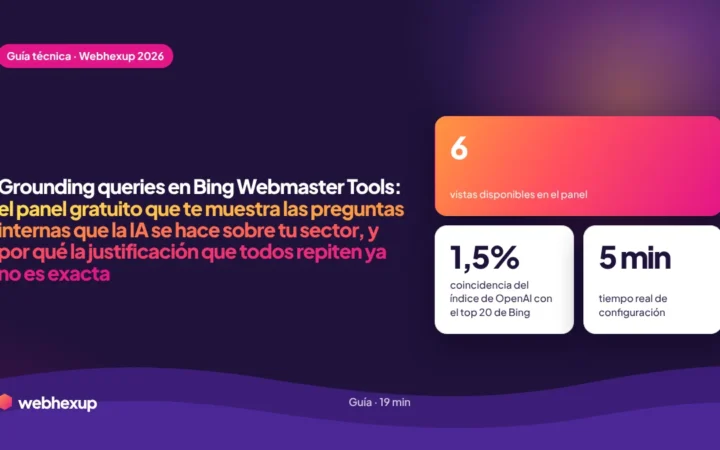
That isn't my opinion. In my piece on grounding queries in Bing Webmaster Tools I documented research showing that OpenAI runs its own retrieval index, with minimal overlap against Bing's results. If ChatGPT uses neither Google's index nor Bing's, optimizing for Google guarantees you nothing there.
Perplexity follows its own patterns
Perplexity cites sources transparently, with numbered links, and favors recent, well-structured content. Its retrieval behavior isn't Google's. In my experience working both, new content enters Perplexity considerably faster than any other engine.
What survives from the GEO work
| Work | Is it SEO for Google? | Does it add value outside Google? |
|---|---|---|
| Technical SEO and crawlability | Yes, it's the foundation | Yes, every engine has to read you |
| Useful content with authority | Yes | Yes |
| Direct-answer structure | Yes, that's good SEO | Yes, it favors citation |
| Tracking mentions in ChatGPT and Perplexity | Not applicable | Yes, that's distinct work |
| Content for gaps found in non-Google engines | Not applicable | Yes, that's distinct work |
| llms.txt as an on-ramp | Doesn't work | No public evidence |
Those two middle rows are, as I read it, the only things that legitimately justify billing something different from ordinary SEO. Everything else is SEO done well, and should be invoiced as such.
What GEO costs
in the real market.
I pulled published pricing so I could give you references instead of opinions. Here's what I found, with sources so you can verify.
| Market | Monthly range | Source |
|---|---|---|
| U.S. agency, full range | $1,500 to $50,000 | WebFX |
| U.S. small business | $1,500 to $5,000 | TeamAI |
| U.S. mid-market | $3,000 to $25,000 | RevvGrowth |
| U.S. enterprise | $25,000 to $50,000 | TeamAI |
| Monitoring tools | $10 to $1,000 | WebFX |
| European agency | €500 to €5,000 | MakeYourTale |
The spread between $1,500 and $50,000 tells you something: there's no settled standard for what this service includes. Which is exactly why the question below matters more than the number.
If a proposal splits SEO and GEO into two line items, ask what's in the GEO line that isn't SEO. If the answer includes llms.txt, chunking, or schema framed as an AI shortcut, you're paying twice for the same work. If the answer is tracking in non-Google engines and content targeting gaps found there, that's genuinely different work.
How to spot
someone selling you air.
Four questions you can ask in a sales call. The answers tell you a lot.
They guarantee you'll show up in ChatGPT. Nobody can guarantee that. Models change, indexes refresh, and citation isn't for sale. What can be offered is tracking, systematic work, and an honest report of what moves.
The GEO package costs more than the SEO one and nobody explains what's different inside it. If GEO is more expensive, the difference has to be work SEO doesn't do. Ask for it itemized in the proposal.
They don't mention Google's guidance. In late 2026, an agency selling GEO that doesn't know Google's official position isn't keeping up with its own field. Or it knows and would rather you didn't.
They show you a measured baseline before starting and explain how they'll track progress. Without an initial snapshot there's no way to prove anything later, and an agency that starts without one either can't measure or would prefer you couldn't.
Frequently asked questions about
GEO and Google's position.
What exactly did Google say about GEO and AEO?
In official guidance published May 15, 2026 and updated June 5, Google wrote that from Google Search's perspective, optimizing for generative AI search is optimizing for the search experience, and thus still SEO. The guidance treats GEO and AEO as part of SEO, not as separate disciplines.
So is GEO a scam?
Not necessarily, but read the fine print. For Google's AI features, Google says no separate framework is needed, and it's right. Outside Google there is distinct work: ChatGPT runs its own index and Perplexity has its own retrieval patterns. The problem isn't GEO itself — it's billing it as a new discipline when most of the work is ordinary SEO.
Does llms.txt do anything?
Google listed it among things not needed to appear in its AI features. Other engines haven't issued equivalent statements. My read: it still makes sense as documentation of which content to prioritize, but promising it as an on-ramp to AI Overviews was wrong, and I'll say so plainly.
Which tactics does Google say aren't needed?
Five: the llms.txt file, content chunking for AI, machine-friendly rewrites aimed at models rather than readers, inauthentic mentions seeded on other sites, and schema framed as a shortcut to citation. Schema still works for rich results — what Google debunks is using it as an AI hack.
What should a GEO service cost?
Published U.S. ranges run from $1,500 to $50,000 per month depending on scope, with small business typically $1,500 to $5,000 and mid-market $3,000 to $25,000. European agencies publish €500 to €5,000. The number matters less than what's inside: if the GEO line contains nothing SEO doesn't already do, you're paying twice.
Can anyone guarantee my brand shows up in ChatGPT?
No, and anyone guaranteeing it is promising something they don't control. Models change versions, refresh their knowledge and modify retrieval systems. What can be offered is systematic tracking, technical work that raises the odds of being cited, and an honest report of what moves and what doesn't.
If I already do technical SEO, do I need to buy GEO separately?
For Google's AI features, no — that work is already done. Where additional work can make sense is tracking mentions in ChatGPT and Perplexity, and producing content aimed at gaps found in those engines. If what you're being offered isn't that, ask for an explanation before agreeing to an extra charge.