

With nearly 20 years of experience managing digital campaigns in Colombia, I can tell you that Meta Ads is the channel that most Colombian companies set up incorrectly—not due to a lack of budget, but due to a lack of strategy regarding creative assets and targeting. A well-executed Meta campaign can generate leads at a cost 30% to 60% lower than Google Ads in consumer goods sectors. A poorly executed one burns through the budget on impressions that don’t convert.
This guide explains how Meta Ads works, how to set it up step by step, and the keys to ensuring Colombian campaigns generate real results. If you want to compare Meta Ads with other channels first, read “Google Ads vs. SEO in Colombia.” And if you’ve already decided to get started, at Webhexup we offer professional Meta Ads management in Colombia.
How does Meta Ads
work in Colombia?
Meta Ads operates on an auction system similar to Google Ads but with a key difference in intent: while Google captures active demand (the user is searching for something), Meta generates latent demand by showing ads to people who match your ideal customer profile even if they aren’t actively searching at that moment.
The system evaluates three factors to decide which ads to show and to whom: the advertiser’s bid, the estimated quality and relevance of the ad to the target audience, and expected conversion rates. A highly relevant ad may have a lower cost per impression than an irrelevant one with a higher bid—the logic is identical to Google Ads’ Quality Score.
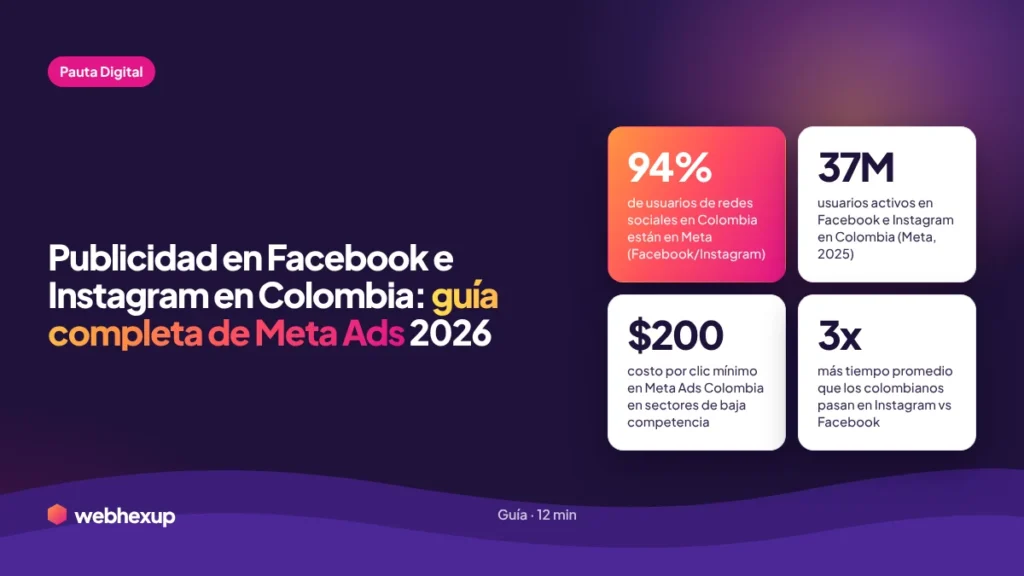
In Colombia, Meta has behavioral data on more than 37 million active users on Facebook and Instagram. This database of behaviors and interests allows for targeting with a precision unmatched by any other channel: you can reach exactly people aged 28 to 45 in Medellín who are interested in fitness, have visited sportswear websites in the last 30 days, and frequently shop online. This targeting capability is why Meta Ads is the primary acquisition channel for many Colombian consumer brands.
Meta Ads vs. Google Ads:
When to Use Each in Colombia.
| Factor | Meta Ads | Google Ads |
|---|---|---|
| Type of Demand | Latent demand — interrupts with relevance | Active demand — capture search intent |
| Primary targeting | Interests, behaviors, demographics, lookalike | Keywords — what the user is searching for |
| Ad format | Visual: image, video, carousel, Stories | Text, Shopping, Display, YouTube |
| Best for | E-commerce, fashion, beauty, education, mass-market services | High-intent services: legal, medical, automotive |
| Average CPC in Colombia | $200 – $2,500 COP | $400 – $15,000 COP |
| Time to results | From day one; learning curve: 1–2 weeks | From day one, learning curve: 2–4 weeks |
| Sales cycle | Short — ideal for impulse buys or consideration | Short to medium — captures the moment of decision |
The synergy between the two channels is powerful: Meta Ads builds brand awareness and captures audiences in the consideration phase, while Google Ads captures that same audience when they finally perform a search. Many successful Colombian campaigns use Meta for the top of the funnel and Google for the bottom. At Webhexup, we manage integrated digital advertising by coordinating both channels.
Structure of a well-configured Meta Ads campaign
.
Meta Ads organizes campaigns into three hierarchical levels. Understanding this structure is essential for properly managing your budget and targeting:
Audience
targeting in the Colombian market.
Targeting is where Meta Ads has its greatest competitive advantage. These are the most relevant options for Colombian businesses:
Interest and Behavioral Audiences
Meta allows you to target by interests (fitness, fashion, technology, travel), purchasing behaviors (frequent online shoppers, premium device users), and demographics (age, city, education level). For Colombia, always segment by specific city—purchasing behaviors in Bogotá, Medellín, and Cali differ, and CPCs vary significantly.
Lookalike Audiences—the Best Multiplier
Meta’s lookalike audiences automatically create segments of users similar to your best customers. If you upload an email list of customers who have made a purchase in the last 6 months, Meta finds people with similar behavior patterns in Colombia. Lookalike audiences representing 1% to 3% of the Colombian market tend to perform best—specific enough to be relevant but with sufficient volume for the algorithm to learn.
Retargeting — the Most Cost-Effective
Retargeting shows ads to people who have already interacted with your brand: they visited your website, watched a video, or engaged with your Facebook or Instagram page. In Colombia, retargeting typically has an ROAS between 3x and 8x that of prospecting campaigns—because you’re reaching people who have already expressed interest. It requires the Meta Pixel to be properly installed on your website. According to Meta’s official documentation, the Pixel must be installed before launching any campaign to collect audience data from the start.
Ad creatives that convert
in the Colombian market.
In Meta Ads, creative is the number one performance factor. A change to an image or the first three seconds of a video can multiply a campaign’s results by 3 or 5 with identical targeting and budget. Meta’s algorithm learns which creatives work—but it needs quality material to optimize.
- 15- to 30-second videos with a hook in the first 3 seconds
- Real people using the product—not stock images
- Visible social proof: reviews, number of customers, ratings
- Price or discount visible in the creative
- Clear and urgent CTA: “Order Today,” “This Week Only”
- Generic corporate images without a clear value proposition
- Videos with a logo for the first 5 seconds and no content
- Long copy without a hook in the first two lines
- Identical creative assets with no variation for more than 3 weeks
- No subtitles in videos—85% of videos are watched without sound
The copy—the ad text—also has a huge impact. In Colombia, casual and direct language works better than corporate language. The first line of the copy is critical because Meta truncates the text—the user only sees the first two or three lines before the “See More” button. Those first lines must address the customer’s problem or the value proposition, not the company name.
Ad formats on Meta
and when to use each one in Colombia.
| Format | Best for | When to Use It in Colombia |
|---|---|---|
| Static Image | Direct offers, quick launches | When the value proposition is visual and clear: product, price, CTA |
| Video (15–30s) | Product demonstrations, testimonials | The format with the widest organic reach. A must for brand awareness campaigns |
| Carousel | Product catalog, multiple benefits | E-commerce featuring multiple products or services—users swipe and choose |
| Stories and Instagram Reels | Young audience, Colombia, ages 18–34 | Full-screen vertical format. High engagement rate in Colombia |
| Lead Ads (native form) | Lead generation without leaving Meta | When the website isn’t well optimized or on mobile, where conversion rates drop |
| Dynamic catalog | E-commerce product retargeting | Automatically display the specific product the user viewed on the site |
Budgets and key
metrics for Meta Ads in Colombia.
The minimum budget required for Meta Ads to function properly in Colombia depends on the objective. With less than $500,000 COP per month, the algorithm does not have enough data to optimize. These are the actual ranges for the Colombian market in 2026:
Brand awareness — starting at $300,000 COP/month
Reach and impression campaigns to raise brand awareness. The cost per thousand impressions (CPM) in Colombia ranges from $3,000 to $15,000 COP, depending on the audience. Useful for new brands that need to establish a presence before launching conversion campaigns.
Lead generation — starting at 800,000 COP/month
Campaigns aimed at generating potential customers. The cost per lead in Colombia varies widely by sector: between 8,000 and 25,000 COP for education and mass-market services, and between 30,000 and 120,000 COP for high-ticket services such as real estate or enterprise technology.
Metrics to Monitor Weekly
- CPM (Cost per thousand impressions): measures the cost of reach. If it rises without an improvement in conversions, the audience is experiencing ad fatigue—you need to refresh your ad creatives.
- CTR (Click-through rate): the percentage of people who click on the ad out of those who see it. A CTR below 1% indicates that the creative isn’t generating interest among the target Colombian audience.
- CPL (Cost Per Lead) or CPA (Cost Per Acquisition): the most important metric for lead generation and sales campaigns. If it’s above the profitability threshold, you need to adjust the audience, creative, or landing page.
- Frequency: the average number of times each person in the audience has seen the ad. When it exceeds 3 to 4 times, performance drops—the audience is already saturated with that ad.
Mistakes that waste
the most budget on Meta Ads Colombia.
No Pixel Installed Before the Campaign
The Meta Pixel must be installed weeks before launching any campaign to collect visit data. Launching without the Pixel means losing the ability to retarget and optimize for conversions—the two most valuable features of Meta Ads.
Changing settings before the learning phase is complete
Meta needs between 7 and 14 days of learning before the algorithm begins to optimize. Changing the budget, audience, or ad during this phase resets the learning process and wastes the accumulated investment.
Audience too small or too broad
In Colombia, an audience of fewer than 200,000 people does not provide enough volume for the algorithm to optimize. An audience of more than 5,000,000 without additional segmentation dilutes relevance. The sweet spot for most Colombian campaigns is between 500,000 and 2,000,000 people.
Failing to refresh creatives every 3 weeks
Ad fatigue on Meta sets in faster than on any other channel. When frequency exceeds three times, the CTR drops and the CPM rises. In Colombia, with relatively small audiences, this happens within 2 to 4 weeks. Without a continuous creative production plan, campaigns lose effectiveness.
