
I’ve been doing SEO for YMYL sectors in Colombia for nearly 20 years, and plastic surgery is probably the most demanding of them all. I’ve seen excellent clinics with surgeons who are members of the SCCP lose their Google rankings because their websites promised guaranteed results, published before-and-after photos without informed consent, or used copy that an ethical doctor would never approve. And I’ve seen mediocre clinics rank first because they understood that medical SEO isn’t aggressive advertising—it’s about building verifiable technical authority.
This guide is designed for board-certified plastic surgeons, cosmetic clinic managers, and marketing directors at specialized private healthcare institutions (IPS). I’ll explain how to build an SEO strategy that simultaneously complies with the SCCP’s guidelines, the restrictions of Law 1799, the regulations on misleading advertising, SUPERSALUD’s licensing criteria, and Google’s YMYL guidelines. If, after reading this, you’d like to apply this framework to your clinic, Webhexup offers specialized SEO services for aesthetic medicine clinics in Colombia.
Plastic Surgery in Colombia:
Market Statistics for 2026.
Before we talk about SEO, it’s important to understand that your clinic isn’t competing with the one down the street—it’s competing with clinics in Turkey, Mexico, Thailand, and Brazil for patients who are comparing prices, credentials, and reviews on Google from Miami, Madrid, or Toronto. That’s the reality of the Colombian plastic surgery market in 2026.
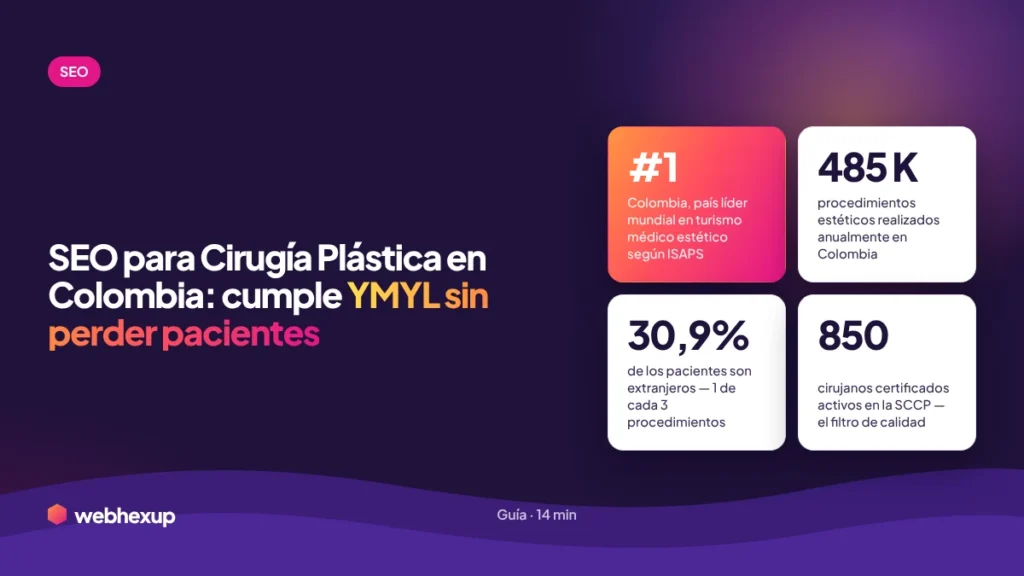
The data confirms the scale of this market. According to the Colombian Association of Plastic Surgery Clinics (ASOCLICPER), Colombia is the world’s leading destination for medical tourism related to cosmetic procedures, surpassing even Turkey, Mexico, and Thailand—countries that receive massive government investment in this sector. The International Society of Aesthetic Plastic Surgery (ISAPS) reported that more than 485,000 cosmetic procedures are performed annually in Colombia, with 180,000 international patients and 15% growth projected for 2024.
Medellín alone treated more than 20,000 international patients in 2023, generating $61,000 million in revenue, making plastic surgery the medical service that generates the most revenue from foreign patients in the city. Bogotá, Cali, Cartagena, and the Caribbean Coast account for the rest of the demand, with significant patient flows from the United States, Venezuela, Ecuador, Panama, and the Caribbean. SCCP President Damaris Romero summed it up at the 5th Patient Safety Symposium: the combination of academic tradition, technology, costs 40% to 70% lower than in the United States, and word-of-mouth from international patients is what sustains this global position.
The Two Associations That Determine Your SEO Authority
There are two acronyms your website must display prominently if you want to rank for YMYL plastic surgery: SCCP and ASOCLICPER. The Colombian Society of Aesthetic and Reconstructive Plastic Surgery (SCCP), founded in 1956, certifies individual surgeons—it currently has 850 active members listed in its public directory. ASOCLICPER, on the other hand, certifies the clinics and centers where procedures are performed. A reputable clinic holds both certifications.
This matters for SEO for a specific reason: Google evaluates the authority of medical websites by cross-referencing recognized entities. When your site links with rel="external" to the SCCP’s official directory to verify the surgeon’s membership, adds a Person schema with hasCredential pointing to that membership, and displays the ASOCLICPER seal in the footer with a link to the clinic directory, you’re giving Google the authority signals it needs to distinguish you from so-called “clandestine clinics” that the Ministry of Health itself warns are dangerous.
Regulations your website
must follow to avoid damaging your reputation.
Medical SEO in Colombia operates within a strict regulatory framework that many generalist agencies ignore. If your SEO agency doesn’t understand these rules, it could get you into legal trouble while trying to improve your search rankings. Here are the four rules you need to know:
| Regulation or Entity | What it regulates | Direct SEO Implication |
|---|---|---|
| Law 1799 of 2016 | Restrictions on advertising and modeling involving minors | Prohibits the use of images of minors in cosmetic advertising |
| Law 2068 of 2020, Art. 19 | General Framework for Health Tourism in Colombia | Allows advertising to international patients with specific conditions |
| INVIMA | Regulates medical devices and implants | You may not mention implant brands without verifiable INVIMA registration |
| SUPERSALUD / Accreditation | "Authorized" status is mandatory for clinics | Your website must display the authorization code prominently |
| Misleading Advertising Regulations (Art. 30) | Liability for Damages Caused | Guaranteeing results constitutes actionable misleading advertising |
| Bill 260/20 | Greater regulation of cosmetic advertising | Trend toward stricter restrictions |
| SCCP Code of Ethics | Industry guidelines | You cannot use “before-and-after” images without informed consent |
Informed Consent for the Publication of Images
The most costly mistake I see Colombian plastic surgery clinics repeatedly make is publishing before-and-after photos of patients without specific, written informed consent for digital advertising purposes. The surgical consent form that the patient signs for the procedure does not automatically include authorization for their image to appear on Instagram, Google, or the clinic’s website. These are two separate consents.
A patient who recognizes her own body on your site without having authorized that specific publication can sue you for violation of the right to data privacy, emotional distress, and breach of medical confidentiality. And whether you lose or win the case, Google will detect the conflict when it receives reports from the patient and may impose manual penalties that take months to reverse. The correct solution is to document separate digital consent forms, each with a specific purpose (website, social media, academic conferences) and an effective date. To learn more about handling sensitive information, I recommend our 2026 Google EEAT guide for Colombian websites.
Medical EEAT:
The Four Non-Negotiable Pillars.
EEAT—Experience, Expertise, Authoritativeness, Trustworthiness—is the framework Google uses to evaluate the credibility of YMYL sites. Plastic surgery is likely the strictest category within YMYL because it combines real physical risks with significant financial decisions and international migration. Google applies stricter filters here than in any other sector. These are the four pillars your site must meet:
Experience — Documented surgical experience
Verifiable number of procedures performed, cases published in indexed scientific journals (PubMed, Scielo), participation in SCCP or ISAPS conferences with downloadable materials, academic surgical videos. Experience isn’t claimed—it’s documented. An “About the Surgeon” page with a generic paragraph won’t convince Google or generative AI models.
Expertise — Verifiable academic training
Undergraduate university, a plastic surgery residency lasting at least 4 years, a fellowship where applicable, Rethus registration, a professional license issued by the Ministry of Health, and verifiable active SCCP membership listed in a public directory. If your site claims “expert” without these credentials, Google won’t believe you—and neither will informed patients.
Authoritativeness — Recognition by the Professional Community
Leadership positions in the SCCP, ASOCLICPER, or international societies (ISAPS, ASPS); publications in peer-reviewed journals; external citations in specialized media; conference presentations. Natural backlinks from Colombian academic sites such as universities, university hospitals, or scientific publications. Authority is granted by your peers, not your marketing agency.
A plastic surgery clinic that meets all four EEAT pillars provides Google with the signals it needs to distinguish it from informal operators and rank it higher in international searches. A clinic that fails to meet at least two of the pillars almost never achieves a sustained top-3 ranking for competitive keywords, no matter how much it invests in technical SEO.
Real keywords by procedure
and by Colombian city.
The Colombian plastic surgery market is segmented by three search axes: specific procedure, city, and patient origin (local vs. international). These are the keywords that convert best according to my analysis of SERPs during the first quarter of 2026:
| Keyword | Approx. Monthly Volume | Difficulty | Patient Type |
|---|---|---|---|
| plastic surgeon medellin | 2,400 | High | Mixed (local + international) |
| Plastic surgery prices in Colombia | 1,900 | Medium-High | International with high intent |
| Tummy Tuck in Bogotá | 880 | Medium | Local with advanced intent |
| Breast Augmentation in Colombia | 1,300 | High | Mixed, high copay |
| Rhinoplasty in Medellín price | 720 | Medium-High | International Comparison |
| Recommended plastic surgeon in Bogotá | 590 | High | Final decision, high confidence |
| BBL Colombia | 2,900 | High | International (U.S.) |
| Liposuction in Cali | 480 | Medium | Local with quote |
| Medical Tourism in Colombia: Plastic Surgery | 1,000 | Medium-High | International (research phase) |
| Plastic surgeon in Cartagena | 320 | Medium | International + domestic |
| Abdominoplasty Recovery | 1,600 | Average | Postoperative care + preliminary evaluation |
| Reconstructive Plastic Surgery in Colombia | 260 | Medium-Low | Specialized, high intent |
The strategy that works best for Colombian plastic surgery is to create dedicated pages for each procedure (tummy tuck, rhinoplasty, BBL, breast augmentation, liposuction) with reliable medical information—risks, contraindications, recovery, realistic expectations—and then subdivide those pages by city when applicable. This structure signals to Google that your site has deep subject-matter authority, not just commercial pages.
Content that ranks
without violating the medical code of ethics.
The mistake that ruins SEO for most plastic surgery clinics is publishing content written by copywriters without medical review. Google detects this immediately because it checks for signals such as the correct use of anatomical terminology, mention of actual contraindications, citations to indexed medical literature, and consistency between the stated author and the topics covered. An article on rhinoplasty written by a freelancer who copied from Wikipedia won’t fool either Google or an informed patient.
Framework for a Medical Article That Actually Ranks
This is the minimum structure a surgical blog article must have to rank well and be cited by generative AI models such as Google AI Overviews:
- Exact search query as the H1 heading, matching the patient’s search query. Not “Reflections on Rhinoplasty” but “Rhinoplasty in Colombia: What to Expect, How Much It Costs, and How to Choose a Surgeon.”
- Direct answer within the first 50 words—a citable AEO block as a featured snippet. Specific, not generic.
- Actual surgical indications—which patients are candidates, which patients are NOT candidates, and the selection criteria applied by the surgeon.
- Technical procedure explained—anesthesia, surgical duration, INVIMA-registered supplies, required medical equipment. This demonstrates real expertise.
- Risks and contraindications with real figures—where most fail out of fear of “scaring” the patient. Google rewards medical transparency.
- Day-by-day recovery with realistic expectations—not just photos from month 12 without showing the first week of swelling.
- MedicalProcedure + Person + Organization schema—complete structured markup that helps Google understand that this is authoritative medical content.
- Author identified with a complete bio—Person schema with SCCP credentials, jobTitle, alumniOf, and hasCredential.
- FAQ with 5+ real questions — extracted from Search Console and from questions they actually receive during consultations.
The thematic cluster: pillar page + procedure pages + educational blog
A clinic that publishes isolated articles loses out to one that builds thematic clusters. The optimal architecture for a Colombian plastic surgery clinic is: an extensive pillar page on “Plastic Surgery in Colombia: Complete Guide 2026” as a hub, a dedicated landing page for each major procedure (at least 8: abdominoplasty, rhinoplasty, BBL, breast augmentation, liposuction, facelift, blepharoplasty, breast reduction), a medical tourism section with a comprehensive guide for international patients, and a blog with educational satellite articles linked to each procedure landing page. This architecture signals to Google that your site is the subject authority on plastic surgery in Colombia.
To better understand how content cluster architecture works in professional YMYL sectors, you can supplement this with our technical SEO guide for professional websites.
Mistakes that result in penalties for plastic surgery clinics
on Google.
Guaranteeing aesthetic results
"Guaranteed results" or "your new body in 6 hours" are considered misleading advertising under Colombian law and violate the SCCP code of ethics. Google penalizes them as false promises in YMYL. All surgery carries risks and variable outcomes: communicate this honestly.
Before-and-after photos without consent
Publishing images of patients without specific digital authorization violates data protection laws, medical confidentiality, and the code of ethics. If a patient reports to Google that a photo of her own body was published without permission, you’ll receive a manual penalty that takes months to reverse.
Fake or Paid Reviews
Paid reviews on Google are being detected more and more effectively. The SCCP also prosecutes these practices as unfair competition. The penalty is severe: loss of Local Pack visibility, suspension of your Google Business Profile, and lasting reputational damage among fellow surgeons.
AI-Generated Content Without Medical Review
Publishing articles generated by ChatGPT without review by a board-certified surgeon may contain dangerous anatomical or regulatory errors. Google massively demoted YMYL sites with AI-generated content lacking added value in the March 2026 Core Update. Medical review is mandatory.
The Essentials of SEO for Plastic Surgery
in Colombia 2026.
Colombia is the world’s leading destination for medical tourism in plastic surgery according to ISAPS, with 485,000 procedures annually and 180,000 international patients (1 in every 3 procedures). Medellín leads the way with 20,000 foreign patients and $61,000 million in revenue in 2023. The SCCP has 850 certified surgeons listed in a public directory. Reputable clinics have SCCP accreditation for surgeons, ASOCLICPER certification, and a visible SUPERSALUD license.
SEO for plastic surgery in Colombia operates under strict regulations: Law 1799 of 2016 (advertising to minors), Law 2068 of 2020, Art. 19 (health tourism), INVIMA oversight of medical devices, mandatory SUPERSALUD authorization, the misleading advertising regime (Art. 30) that prohibits guaranteeing results, the SCCP code of ethics, and Bill 260/20, which points toward increased regulation. Informed consent for the digital publication of images is mandatory and must be documented separately from surgical consent.
Medical EEAT requires four verifiable pillars: Experience (documented procedures, indexed scientific publications), Expertise (specialization of 4+ years, Rethus registration, active SCCP membership), Authoritativeness (leadership positions, peer-reviewed publications, citations in specialized media), and Trustworthiness (visible SUPERSALUD accreditation, complications insurance policy, genuine reviews, privacy policy). Clinics that meet all four pillars dominate Colombian SERPs and capture international traffic with a significantly lower customer acquisition cost (CAC) than those that rely solely on paid advertising.
We answer your questions about SEO
for Colombian plastic surgery.
José Fernando Muñoz Álvarez
SEO consultant specializing in YMYL sectors within health and beauty, with nearly 20 years of experience in digital marketing in Colombia and the United States. Founder of Webhexup. He has provided SEO services to cosmetic surgery clinics, dermatology practices, dentists, and other healthcare professionals in Medellín, Bogotá, Cali, and the bilingual Colombia-U.S. market.


