

This doesn’t mean that SEO is dead—that’s the same old narrative that never comes true. What has changed is the context in which it operates. A website that ranks well on Google but doesn’t appear in the generative responses of AI engines is leaving a growing portion of its potential visibility on the table.
This article explains what each discipline is, how they relate to one another, and how to prioritize them realistically. If you want to start from the beginning, read first about what SEO is and how it works; and if you’re already familiar with the context of AI, check out our guide on what GEO is and how it works.
Why digital
visibility no longer depends solely on Google.
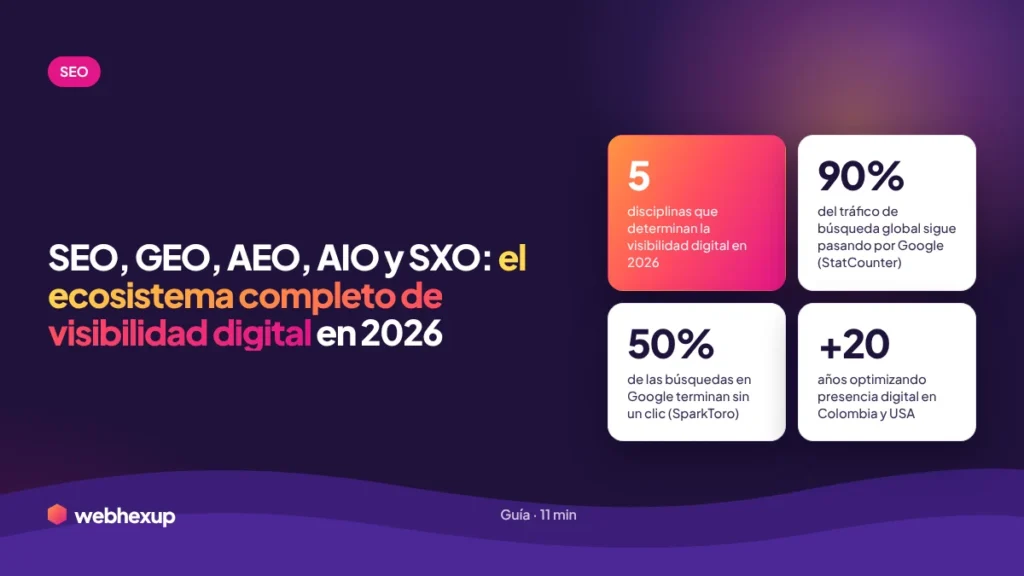
For nearly two decades, digital visibility followed a simple equation: rank on Google, get traffic. That model worked because Google had a virtual monopoly on how people found information online. In many markets, it still accounts for between 85% and 92% of search traffic, according to StatCounter. That hasn’t changed dramatically.
What has changed, however, is user behavior. A growing proportion of searches that used to go to Google now go directly to ChatGPT, Perplexity, or a phone’s voice assistant. They aren’t the majority yet—but they are the fastest-growing segment. And companies that aren’t optimizing for these channels are losing visibility to competitors who are.
The answer isn’t to abandon SEO. It’s to understand that SEO is now the foundation of a broader ecosystem of five complementary disciplines—and that sharing a single, well-executed piece of content can generate visibility across all those channels simultaneously.
SEO: The Foundation That
Isn’t Going Away.
Search Engine Optimization remains the central discipline of digital visibility. It involves optimizing your website so that Google and other search engines can find it, understand it, and display it in relevant positions when someone searches for something related to your business.
Its three pillars are technical SEO (speed, structure, proper indexing), on-page SEO (content optimized with the right keywords and the appropriate search intent), and off-page SEO (domain authority built through high-quality backlinks).
What Google’s algorithm in 2026 values above all else is the E-E-A-T concept:
The good news: well-executed SEO content—high E-E-A-T, clear structure, verifiable data, visible authorship—is also the best starting point for GEO, AEO, and AIO. Well-done SEO in 2026 is the foundation for everything else.
GEO: Be the source that
generative engines cite.
Generative Engine Optimization is the adaptation of SEO to the ecosystem of engines that generate responses in natural language—Google AI Overviews, Perplexity, ChatGPT with web search, Gemini, and those yet to come. These engines do not display a list of links: they generate their own response and cite the sources on which they are based.
The fundamental difference from traditional SEO is that in GEO, you’re not competing for a ranking on a list—you’re competing to be mentioned within a generated response. According to a 2024 study on GEO by Princeton, Georgia Tech, and NYU, the tactics that most effectively increase visibility in generative engines are: including verifiable statistics, citing authoritative sources, using fluent language, and optimizing the factual clarity of the content.
In practice, this translates to: straightforward, self-contained paragraphs that can be extracted and quoted without losing meaning; correct Schema Markup so the engine understands what type of entity the content is; data with verifiable sources; and clear authorship with real credentials. It’s essentially E-E-A-T taken to the extreme in terms of machine readability. At Webhexup, we include GEO optimization in our GEO SEO and AI service.
AEO: gaining visibility
without relying on clicks.
Answer Engine Optimization focuses on optimizing content to appear in Google’s direct answer sections: featured snippets (answer boxes in position zero), the “People Also Ask” (PAA) sections, Google Assistant responses, and voice searches.
Here’s why it matters: According to data from SparkToro, less than 50% of Google searches result in a click to an external site. Users find the answer directly in the search result. If that answer comes from your content, you gain visibility and brand authority—even if the user hasn’t visited your site.
How to Optimize for AEO
The structure that supports AEO is simple but must be applied with discipline: answer the main question in the first two or three paragraphs of the article in 40 to 60 straightforward words, use subheadings in question format (“WhatWhat is X?”, “How does Y work?”), include well-developed FAQ sections, and use FAQPage Schema Markup in JSON-LD. AEO doesn’t require content different from that used for SEO—it requires that the same content be organized in a way that allows a machine to extract the answer without having to read the entire article.
AIO: Get language
models to recognize and cite you.
AI Optimization—also known as LLMO (Large Language Model Optimization)—is the newest and least defined discipline in the ecosystem. It refers to optimizing a brand’s digital presence so that language models like GPT-4, Claude, Gemini, or Llama include it in their responses when someone asks about related topics.
The key difference from GEO is that AIO works primarily with the models’ training data—not with real-time searches. A model like GPT learns from sources such as Wikipedia, academic publications, specialized forums, code repositories, and high-authority articles. If your brand, products, or expertise appear consistently and verifiably in these sources, the model will include them in its responses.
AIO tactics include: building a verifiable presence in sources that LLMs prioritize (Wikipedia when applicable, industry publications, interviews in authoritative media, mentions in specialized forums such as Reddit or Quora), generating machine-readable content (semantic HTML, Schema Markup, structured data), and maintaining consistency in the entity’s description—name, role, specialty—across all digital channels. It’s link building and digital PR, but designed so that AI models can learn about you.
SXO: From Visibility
to Actual Conversion.
Search Experience Optimization is the discipline that connects search traffic with actual business results. It combines SEO with UX (user experience) and CRO (conversion rate optimization). The goal is for users arriving from a search not only to find what they were looking for—but also to have an experience good enough to turn them into customers.
SXO addresses a reality that many marketing teams overlook: appearing as the top result on Google is worthless if the user visits the site, sees a slow, confusing page, or one that doesn’t exactly match their search intent, and leaves within eight seconds. That behavior—known as “pogo-sticking”—tells Google that the result was not useful, which eventually harms search rankings.
The Three Pillars of SXO
- Speed and Core Web Vitals: A site that takes more than 3 seconds to load loses, on average, 53% of mobile users, according to data from Think with Google. Core Web Vitals are the metrics Google uses to evaluate that experience.
- Intent Alignment: The page’s content must precisely match the search intent that brought the user there. A services page for an informational keyword, or a blog post for a transactional keyword, results in immediate abandonment.
- CRO — Conversion Optimization: Clear CTAs, short forms, a value proposition visible without scrolling, and social proof (reviews, success stories). Conversion doesn’t happen on its own—it’s designed.
SXO is why at Webhexup we build websites with conversion-oriented design from day one—not as a decorative layer but as an integral part of the SEO strategy.
How the five disciplines differ
and how they complement each other.
| Discipline | Where it appears | What Measures Success | Key Points |
|---|---|---|---|
| SEO | Google organic results | Rank, organic traffic, CTR | Technical, content, authority (backlinks) |
| GEO | AI Responses: Overviews, Perplexity, Gemini | Citation frequency in AI responses | Factual clarity, Schema Markup, E-E-A-T |
| AEO | Featured snippets, PAA, voice search | Position Zero, Snippet Impressions | Direct answer structure, JSON-LD FAQs |
| AIO | LLM responses (ChatGPT, Claude, Gemini) | Organic mentions in AI responses | Presence in training sources, entity consistency |
| SXO | Any channel that drives traffic to the site | Conversion rate, time on page, bounce rate | UX, speed, CTA, intent alignment |
The relationship between the five is not one of competition—it is one of layers. A well-written article with high E-E-A-T, AEO structure, correct Schema Markup, and a fast, well-designed landing page simultaneously covers SEO, GEO, AEO, and SXO. AIO requires additional work to establish a presence on external sources, but it also draws on the authority built through off-page SEO. These aren’t five separate strategies—they’re five lenses through which to view the same piece of content.
Which one should you start with?
A practical prioritization guide.
The answer depends on the site’s starting point. Here’s the sequence we recommend at Webhexup, based on nearly 20 years of optimizing for businesses of all sizes:
Technical and On-Page SEO—the unshakable foundation
Without the right technical foundation, nothing else works. A site that Google can’t crawl and index properly won’t appear in AI Overviews or in snippets either. Technical SEO is the prerequisite for the entire ecosystem.
AEO + GEO in Every New Article
Starting with the very first article you publish, apply the AEO structure (direct answer in the first few paragraphs, FAQ in JSON-LD) and GEO best practices (self-contained paragraphs, sourced data, Schema Markup). It doesn’t take any extra time—it’s just a different way of writing, nothing more.
Off-Page SEO and AIO — Building External Authority
High-quality link building boosts domain authority for SEO and simultaneously improves visibility in the sources that LLMs use for training. A well-executed digital PR strategy fuels both Off-Page SEO and AIO at the same time.