
I’ve been in digital marketing for almost 20 years and have seen the arrival of Facebook Marketplace, Instagram Shopping, WhatsApp Business Catalog, and several others. TikTok Shop is different: sales don’t come from a static storefront—they come from video. The brand that produces high-quality vertical videos every week wins; the one that just uploads its catalog and hopes people will buy loses. That’s the first thing you need to understand before spending a single peso on this platform.
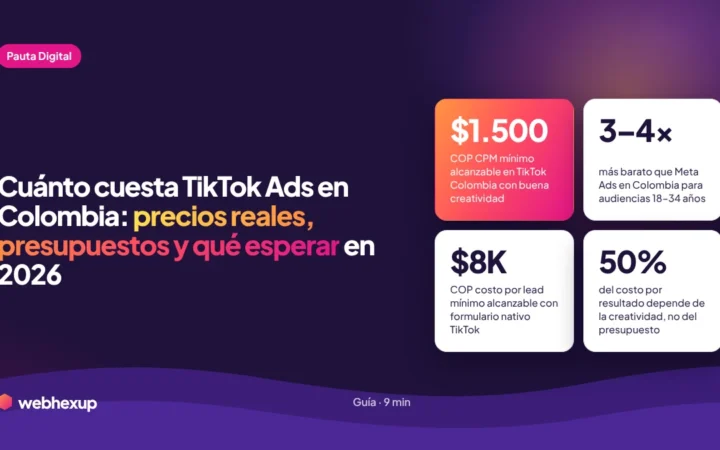
This guide is the one I’m using with clients who want to get into TikTok Shop before their competition. If you first need the general pricing context for TikTok Ads to compare, read How Much Do TikTok Ads Cost in Colombia and “TikTok Ads Colombia: Complete Guide.” Here, we’re focusing on the commercial side: how to sell directly from the video itself.
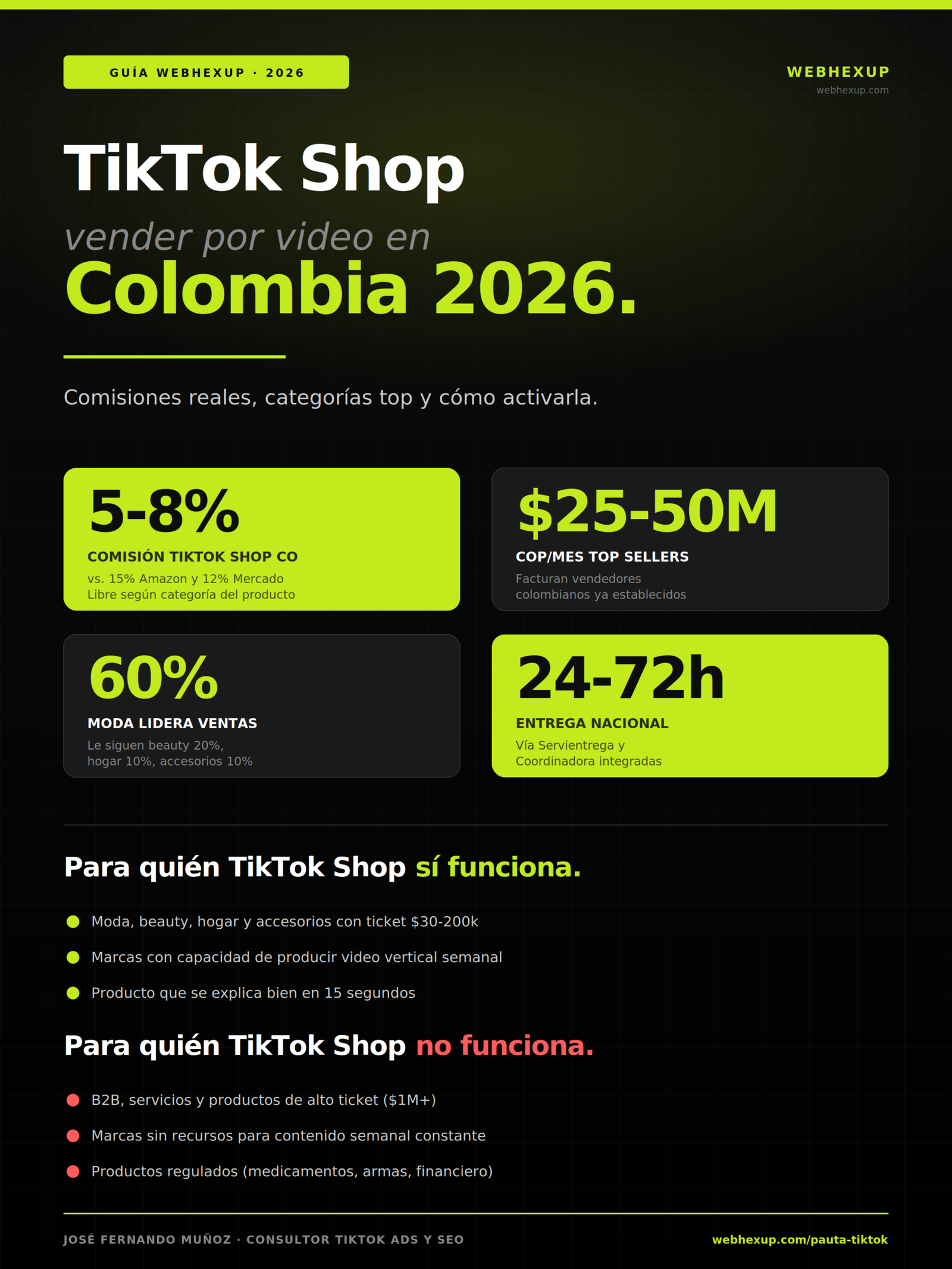
Infographic summary of this guide. Download it, share it with your team, or embed it on your blog using the code below (we just ask that you keep the attribution link).
What is TikTok Shop
and how does it work in Colombia?
TikTok Shop is the e-commerce system integrated into the TikTok app. Instead of users clicking on an external link and leaving the app to make a purchase (as happens on Instagram with the “swipe up” feature), TikTok Shop keeps the entire transaction within the platform: product discovery, purchase decision, payment, and shipment tracking—all seamlessly. This is what we in the industry call “social commerce,” and it’s where TikTok is betting its next decade.
For sellers, there are three ways to sell on TikTok Shop: as a direct store (you upload your products and sell them through your own videos and live streams), as a brand working with affiliate creators (you pay a creator a commission to promote your product in their videos), or as an affiliate creator (you promote other brands’ products and earn a commission for every sale you generate through your link). All three models coexist within the same ecosystem, and serious brands use a mix of them.
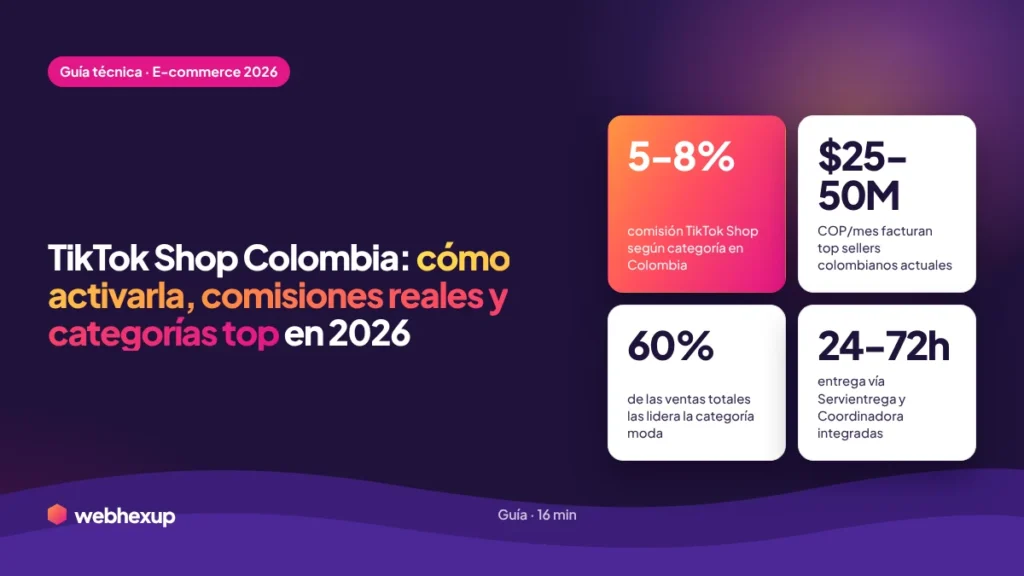
For the buyer, the experience consists of a “Buy Now” button that appears above the video, a product showcase on the seller’s profile, and a dedicated tab in the TikTok search bar. Payments are processed using local methods (PSE, Nequi, Daviplata, credit/debit cards), and logistics are integrated with Colombian carriers to ensure delivery within 24–72 hours.
Is TikTok Shop active
in Colombia in 2026?
The short answer is yes, but it’s in a phased rollout. TikTok did not hold a massive official launch like the one in Spain in December 2024 or the one in Mexico in February 2025. What we’re seeing in Colombia is a phased rollout: first, the affiliate creator program (for those who promote third-party products and earn a commission) was launched, and at the same time, direct seller accounts are being enabled for sellers with a valid RUT and proper documentation.
Here’s what we can verify so far: in Colombia, there are domestic sellers operating with an active orange shopping cart, logistics integrations with Servientrega and Coordinadora are up and running, and payments are being processed through PSE, Bancolombia, Daviplata, and Nequi. Top sellers are generating monthly revenue of between 25 and 50 million COP, according to industry reports such as Kikluxe’s report on TikTok Shop Colombia 2026. What is still missing is an official launch event with a Newsroom, figures from TikTok Colombia, or a massive campaign—suggesting that the platform is assessing the quality of the inventory before opening the floodgates.
The strategic implication is significant: those who enter first win. TikTok’s discovery algorithms reward the first serious sellers in each category with disproportionate organic visibility, because they need to populate the storefront before the mass rollout. Waiting for “things to normalize” means waiting until your competitors already have reviews, sales history, and trust built up with the algorithm.
How much commission does TikTok Shop
charge?
The commission TikTok Shop charges sellers varies by category and country. In Colombia, according to data verified with active sellers on the platform, it ranges from 5% to 8% of the value of each completed sale, depending on the product category. As a point of comparison: in Spain, the standard commission rate as of January 2026 is 9% (including VAT), with a reduced rate of 7% for Electronics and Beauty. It’s reasonable to expect that Colombia will follow a similar model once the launch is finalized.
The platform’s commission isn’t the only cost. When calculating actual profitability, you need to consider three components:
| Cost | Range in Colombia | Details |
|---|---|---|
| TikTok Shop Commission | 5–8% | Based on gross sales value, by category |
| Payment Gateway | 2–3% | PSE, Bancolombia, Daviplata, Nequi, credit/debit cards |
| Logistics (shipping) | 5–12% | Servientrega, Coordinadora; varies by weight and distance |
| Total platform costs | 12–23% | Of the gross sales price |
| Seller’s net margin | 77–88% | Before deducting product cost |
Compare that 12–23% to the 15% Amazon charges just for its platform fee (not including payment processing or logistics) or the 12% charged by Mercado Libre. TikTok Shop is competitive as long as you’re willing to produce videos, because its advantage over traditional marketplaces isn’t just the price: it’s that traffic comes organically through the feed algorithm, not by paying for ads like with Amazon Sponsored Products.
Requirements and documentation
to activate TikTok Shop Colombia.
Before you try to sign up, make sure you have all of this ready. This is the main reason why many Colombian brands get stuck in limbo for weeks: they arrive without the required documentation, and the process gets held up during verification.
- Up-to-date RUT (individual or legal entity): with a business activity compatible with retail trade. If your RUT lists “consulting services,” TikTok will not approve you as a product seller.
- Colombian bank account in the name of the RUT holder: Bancolombia, Davivienda, BBVA, or any bank that supports PSE transfers. The name must exactly match the one on the RUT.
- Valid identification document: valid Colombian ID card for individuals; for legal entities, the legal representative’s ID card.
- Chamber of Commerce (companies): certificate of existence and legal representation issued within the last 30 days.
- Dedicated corporate email address: Do not use the same email address you use to manage your personal TikTok account. Create a specific one for the Seller Center.
- TikTok account in compliance with community guidelines: no active warnings, no recent violations, with published content (not a brand-new, one-day-old account).
- Products that comply with TikTok Shop policies: no regulated items (medications, weapons, financial services, tobacco, gambling), no third-party intellectual property (brand knockoffs), and no adult-rated content.
Once everything is ready, registration takes between 24 and 72 hours to be approved. If not everything is ready, it can take weeks of back-and-forth.
How to activate TikTok Shop
Colombia step by step?
With the required documentation in hand, here’s the process. I’ve walked Colombian clients through this who are already selling, and while TikTok updates certain details of the process every few months, the overall structure remains the same:
- Go to seller.tiktok.com and select Colombia as your country of operation. Do not access the Seller Center for another country, even if you can technically do so: this will cause issues with payments, logistics, and taxes.
- Select the seller type: individual or legal entity. The second option lends more credibility to the algorithm and to buyers, but requires registration with the Chamber of Commerce.
- Upload documentation: Tax ID (RUT), national ID card, or legal representative’s ID; Chamber of Commerce registration if applicable. Make sure the information matches exactly across all documents; even a minor discrepancy will halt verification.
- Link your bank account: the name must match your RUT exactly. TikTok will perform a validation micro-transaction within the next 48 hours.
- Set up your store: name, square logo (minimum 500x500), brand description, return policy (required), and business hours.
- Upload your catalog: For each product, you’ll need an optimized title (up to 80 characters), 3–5 square images of at least 1080x1080, price, stock, weight, and dimensions to calculate shipping costs, and the exact category (not the closest match).
- Integrate native logistics: Servientrega and Coordinadora can be activated from the Seller Center. Rates negotiated by TikTok are typically 15–25% better than if you hire the carrier on your own.
- Link your TikTok account to your store so you can tag products in your videos and live streams.
- Start creating content: at least 3–5 vertical videos per week, using formats that already sell well in Colombia (unboxing, “how it looks when worn,” comparisons, tutorials, product reviews).
Many sellers skip Step 6 (a properly configured catalog) because they want to “get started quickly.” This is the most costly mistake: products with generic titles, poor images, or incorrect categories don’t appear in TikTok Shop’s internal search, and the store fails before it even gets off the ground. If your operation doesn’t have the capacity to produce content weekly, consider supplementing with TikTok Ads to accelerate initial traction.
Which categories sell best
on TikTok Shop Colombia?
The four categories that are performing well in Colombia and the reasons behind them. They all share a common pattern: the product is explained in less than 15 seconds, and the average price point allows for impulse purchases without much deliberation.
Who is
TikTok Shop a good fit for—and who is it NOT a good fit for?
After advising several clients who were considering entering the market in 2026, I have a clear understanding of where the model fits and where it’s a waste of time. Here are the scenarios:
It works well if your business meets these criteria:
It WON’T work if your business falls into any of these categories:
Common mistakes that prevent
TikTok Shop from taking off.
These are the mistakes I see repeatedly on accounts that have been active for 2–3 months without significant sales. All of them are avoidable if you know what to look for before you start:
- Uploading a catalog with generic titles: “White T-shirt” doesn’t show up in search results. “Oversized cotton women’s T-shirt, Korean fashion, Medellín” does.
- Poor-quality product images or images stolen from other brands: this lowers your trust score, and the algorithm buries your store. Use your own photos with a clean background, minimum 1080x1080.
- Failing to respond to messages or comments: Response time affects your store’s ranking. Less than 12 hours is ideal.
- Producing videos that don’t drive sales, just “branding” videos: Videos that perform well on TikTok Shop have a strong hook in the first 3 seconds, show the product in use, and end with a clear call-to-action to add it to the cart.
- Ignoring live streams: 40–50% of the largest sales in Colombia come from live streams, not from posted videos. Schedule at least 1–2 live streams per week when you have enough volume to sustain it.
- Not working with affiliate creators: Even if you produce your own content, an affiliate creator in your category can scale your reach 5–10 times with the right commission.
- High prices without a visible discount anchor: A “strikethrough price” (COP $150,000 → COP $89,000) converts much better than a “normal” price without a reference point.
- Slow shipping and poorly managed returns: Your store’s rating drops quickly; TikTok stops showing your products if your score falls below 4.6/5.
A recurring pattern: brands that “test” TikTok Shop for a week, don’t post, don’t make adjustments, and conclude that “it doesn’t work.” It’s not the platform; it’s that you need at least 60–90 days of consistent content for the algorithm to understand who to show your product to. If your operation can’t keep up with that pace, you’re better off starting with classic TikTok Ads to build traction before moving everything to Shop.
The essentials about TikTok Shop
Colombia in 2026.
TikTok Shop is the e-commerce system built into the TikTok app, allowing users to complete the entire transaction—from discovery to decision, payment, and shipping—without leaving the app. In Colombia, it is rolling out in phases in 2026, following the official launch in Spain (December 2024) and Mexico (February 2025). Local sellers are already operating with an active orange shopping cart, logistics integrations with Servientrega and Coordinadora, and payments via PSE, Bancolombia, Daviplata, and Nequi. Colombia’s top sellers are already generating monthly revenue of between $25 million and $50 million COP.
TikTok Shop’s commission in Colombia ranges from 5% to 8% depending on the category, compared to 15% for Amazon and 12% for Mercado Libre. On top of that, there’s a 2–3% payment gateway fee and a 5–12% logistics fee, for a total of 12–23% in platform costs before deducting the product cost. The categories performing well are fashion (60% of volume), beauty (20%), home goods (10%), and accessories (10%), all with an average order value between 30,000 and 200,000 COP, where impulse buying occurs seamlessly. The requirements to activate the service are an up-to-date RUT with compatible business activity, a bank account in the account holder’s name, a valid ID, Chamber of Commerce registration if the seller is a legal entity, a dedicated email address, and a compliant TikTok account.
TikTok Shop works well with products priced between $30,000 and $200,000, which can be explained in a 15-second video, provided the seller has the internal capacity to produce 3–5 vertical videos per week and a reliable logistics operation. It does NOT work with professional services, B2B, high-priced products, brands without the resources for weekly content, or regulated categories. The most costly mistakes are generic titles that don’t appear in search results, low-quality images, failing to respond to messages within 12 hours, ignoring live streams (which generate 40–50% of large sales), failing to work with affiliate creators, and slow shipping that lowers the rating below 4.6/5. The key rule: the algorithm rewards consistency (60–90 days of steady content), not one-off quality.
We answer your questions about
TikTok Shop Colombia.
José Fernando Muñoz Álvarez
Digital consultant with nearly 20 years of experience managing SEO, Google Ads, Meta Ads, and TikTok Ads for Colombian and U.S. companies. Founder of Webhexup, an SEO-first agency in Medellín that combines digital advertising, SEO, and AI Visibility. Previously, he was a co-founder of Eggs Blogs Casa Creativa and e-ideas Agencia Digital. He shares honest insights on digital strategy and platform updates on LinkedIn (jfmonin).