
Dentists have the strongest E-E-A-T of any profession in Colombia—verifiable academic credentials, international specializations, public RETHUS registrations, and verifiable years of practice. And 95% of them aren’t communicating any of that. Worse still: many publish content, reviews, and before-and-after photos without realizing they’re violating Resolution 1995 of 1999, the patient’s right to data privacy (Habeas Data), or the rules of the Dental Ethics Tribunal. This article outlines the specific legal framework that no other blog in the sector addresses.
I’ve been working with Colombian professionals in digital marketing for years, and dentists represent a vertical with a unique paradox: the sector with the highest per-patient cost in all of outpatient healthcare (implants $2–5M, smile designs $4–15M, orthodontics $2–6M) is also one of the sectors that communicates its credibility the least. Dentists hold degrees from the National University, Javeriana, CES, Antioquia, and Pontificia Bolivariana—credentials that Google identifies as strong signals of E-E-A-T—yet the average website lists them in the footer in 10-pixel font.
This article provides the legal and strategic framework for attracting patients as a dentist in Colombia while complying with current health regulations. If you’d like to delve deeper into the technical analysis with real website audits, supplement this reading with our SEO study for dentists in Colombia, where we audited 20 dental clinics in Medellín, Bogotá, Cali, and Barranquilla. Here, we focus on the aspect that no article in the SERP is covering: the specific Colombian healthcare regulatory framework as it applies to digital marketing.
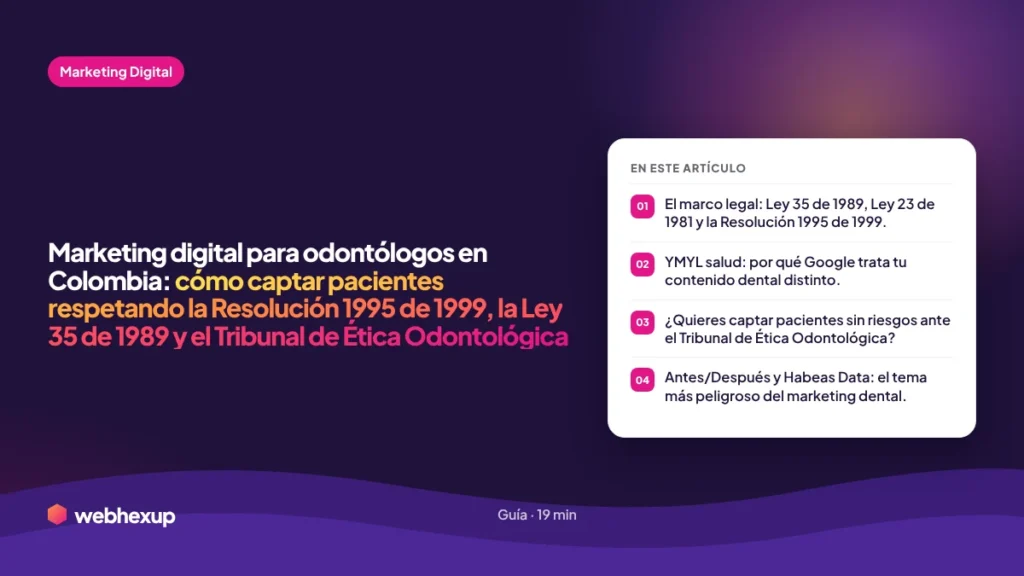
The legal framework: Law 35 of 1989,
Law 23 of 1981, and Resolution 1995 of 1999.
Before discussing SEO, Google Ads, or social media, Colombian dentists must understand their specific regulatory framework. The dental profession in Colombia is governed by a comprehensive set of regulations: Law 35 of 1989 regulates the practice of dentistry, Law 23 of 1981 establishes the Code of Medical Ethics, which applies by extension to dentistry; Resolution 1995 of 1999 from the Ministry of Health sets standards for medical records (including informed consent); Law 1581 of 2012 regulates Habeas Data, and Resolution 2003 of 2014 establishes the accreditation standards that all health care providers must meet.
Disciplinary oversight falls to several entities: the Dental Ethics Tribunal (regional and national), the Colombian College of Dentists (CCO), the Colombian Dental Federation, and the Regional Health Secretariats that issue licenses to individual providers. A dental clinic that does not comply with the Ministry of Health’s licensing requirements not only cannot operate legally—it is also vulnerable to investigations for unlicensed practice if its advertising suggests services for which it is not licensed.
In terms of specific marketing practices, there are five actions that can trigger an investigation by the Dental Ethics Tribunal or the Health Secretariat if carried out improperly. Unlike with lawyers and accountants, where disciplinary sanctions affect only the individual professional, in dentistry, sanctions can also jeopardize the clinic’s license—which amounts to a temporary suspension of operations.
“I guarantee you the perfect smile,” “100% guaranteed results,” “If you’re not happy, we’ll refund your money” are phrases that violate Law 23 of 1981 — healthcare professionals cannot guarantee specific results because they depend on individual biological factors (bone response to implants, soft tissue response, and the patient’s genetics). The only permitted guarantee is for the materials used (for example, a 5-year warranty on Nobel Biocare implants)—never for the clinical outcome. Google Ads also rejects this type of language in healthcare advertising.
This is the most common and most dangerous mistake. A photo of a patient’s treatment—even if it does not show the full face, even if it is “anonymized”—constitutes sensitive personal health data under Law 1581 of 2012 (Habeas Data). Publishing it requires the patient’s express, specific, prior, and informed consent, documented in writing, which clearly identifies the channels where it will be used (website, Instagram, Google Ads, WhatsApp). A generic consent form signed at the start of treatment does not cover subsequent use for advertising purposes. The Superintendency of Industry and Commerce (SIC) penalizes these violations with fines that can exceed 100 million pesos.
“I had 8 implants and was very happy—María Rodríguez, a businesswoman from Bogotá” is a testimonial that violates professional confidentiality (it identifies the diagnosis of a recognizable person) and infringes on medical information protected by Resolution 1995 of 1999. Permitted testimonials are general in nature and should focus on care, professionalism, and the comfort of the facilities—never on specific treatments or identifiable diagnoses. A dentist’s professional reputation is built on authentic reviews on Google Business Profile, professional association recognitions, university teaching, and academic publications.
“50% off dental implants,” “2-for-1 smile makeovers this Friday,” “Free teeth whitening if you bring a friend” are phrases that compromise the professional decorum required by the Code of Medical Ethics. Dentistry is not sold like retail because dental treatments are clinical decisions, not impulse purchases. Furthermore, Google Ads enforces sensitive health policies that frequently reject this type of ad. Pricing communication should be understated, informative, and free of artificial urgency.
A clinic licensed for general dentistry cannot advertise maxillofacial surgery, implantology, or oral rehabilitation without specific authorization for those services from the Department of Health. Resolution 2003 of 2014 establishes licensing standards by service, not by clinic. Advertising unlicensed services constitutes an irregular practice of the profession and may result in the administrative closure of the service, fines, and disciplinary action before the Dental Ethics Tribunal. Before launching advertising campaigns for any treatment, verify that the service is formally licensed at your facility.
What you can certainly do: describe your academic background, the universities where you received your training, your specializations along with the institutions that granted them, years of practice, university teaching experience, academic publications, professional awards, the technology used (including manufacturer and model), visible accreditation from the Ministry of Health, and educational content about treatments that informs without promising specific results. That is the ground on which legitimate dental marketing is built and where the greatest opportunity for competitive differentiation lies—precisely what we documented in our technical study of 20 Colombian clinics.
YMYL Health: Why Google Treats
Your Dental Content Differently.
YMYL stands for “Your Money or Your Life”—the category Google applies to sites whose content can impact people’s health, finances, or safety. Dental content falls squarely into the YMYL category on two simultaneous fronts: it can affect the reader’s health (information on treatments, medications, and surgical procedures) and it can affect their finances (investments ranging from $2 million to $15 million in high-value treatments). This is critical for SEO, yet most articles on dental marketing completely ignore this framework.
The practical consequence: Google applies a higher standard of E-E-A-T (Experience, Expertise, Authoritativeness, Trust) to dental websites than to sites in most other industries. A food blog can rank with generic articles written by freelancers without credentials; a blog about dental implants cannot. Google actively verifies the author’s professional identity, looks for verifiable academic credentials, evaluates the consistency of the entire site, and places specific weight on signals of authority that are secondary in other sectors.
In the study of 20 Colombian dental clinics that we published, we found concrete data confirming this gap: 100% of the sites lack Schema Person for their dentists, 100% lack a correctly implemented Schema FAQPage, and only one clinic (Dentali) publishes its prices publicly. These gaps are particularly costly in YMYL because they are precisely the signals that Google values most highly for health-related topics.
The E-E-A-T signals that will carry the most weight for Colombian dentists in 2026 are: full name with RETHUS professional registration number (Special Registry of Healthcare Personnel) visible on every important page, an “Team” page with specific academic credentials (undergraduate university, graduate school, years of graduation, current teaching positions), a Schema.org Person schema configured with `sameAs` pointing to verifiable academic profiles, visible provider licensing with the Ministry of Health number, technology used with documented manufacturer and model, and educational content consistent with the actual declared specialty.
Another important implication of YMYL in dentistry: cited external sources matter more. In an article about dental implants, citing the Colombian Association of Oral Implantology, the Colombian College of Orthodontics, Medline/PubMed studies, ADA (American Dental Association) protocols, or clinical practice guidelines from the Ministry of Health carries specific weight in rankings. Articles that cite academic sources with direct links consistently rank higher in health-related searches than those that offer opinions without references. This is consistent with Google’s official guidelines on useful content.
Before-and-After Photos and Habeas Data:
The Most Contentious Issue in Dental Marketing.
Before-and-after photos are the most powerful advertising asset in dental marketing—and also the most heavily regulated. Most Colombian dentists post them on Instagram, Facebook, websites, and WhatsApp without complying with the legal requirements of Habeas Data. Ignorance is no excuse: the Superintendency of Industry and Commerce (SIC) has progressively sanctioned healthcare clinics for the improper use of patient images.
What Law 1581 of 2012 Requires for Publishing Patient Images
A person’s image—even if it does not show the entire face—is considered personal data under Colombian law. When the image documents a medical procedure, it becomes sensitive personal data, a category subject to the strictest protections under all data protection regulations. The requirements for using such images in advertising are:
- Express, prior, and informed written consent: not verbal, not implied, and not presumed. It must be signed and dated.
- Stated specific purpose: The consent must indicate exactly how the image will be used (website, Instagram, Facebook, Google Ads, print materials, professional presentations). A generic consent “for marketing purposes” is insufficient.
- Specific channels listed: if the consent authorizes use on Instagram but the image is later published on Google Ads, the additional publication requires new consent.
- Right to revoke consent clearly stated: The patient must be informed that they can withdraw consent at any time, and the clinic must remove the image upon request.
- Handling of Minors: Photographs of minor patients require consent from both parents or a legal guardian, documentation of the relationship, and additional restrictions—and photographs of a minor that are sexualized or framed in an adult manner may never be used.
This means that a consent form signed at the start of treatment—which authorizes the taking of photographs for the medical record—DOES NOT authorize use for advertising purposes. These are two distinct forms of consent. Most Colombian clinics have the first form of consent but not the second, and they use the photographs for advertising purposes at extremely high legal risk.
Safe Alternatives to “Before and After” Photos Featuring Identifiable Patients
There are effective alternatives that eliminate regulatory risk without sacrificing advertising impact:
- Digital renders and simulations: Software such as DSD (Digital Smile Design), Exocad, or Planmeca Romexis allows you to display simulations of the expected result without using images of real patients.
- Cases documented in academic publications: If the case was originally documented for a conference or scientific publication with academic consent, using the academic version (citing the academic context) is safer than reusing the clinical image.
- Before-and-after models under contract: For teeth whitening or smile design, working with models under a specific employment contract eliminates the issue of medical data privacy (the relationship is commercial, not clinical).
- Video testimonials without visible procedures: The patient discusses the process and care received, without the video showing the specific clinical result.
A differentiated
strategy by treatment and price point.
The most common mistake in dental marketing is treating all treatments as if they had the same business dynamics. A $400K teeth whitening procedure and a $12M smile design operate in completely different markets—different patient profiles, different search channels, and different decision-making cycles. The SEO and advertising strategy must be tailored by price point.
| Treatment | Average Price | Decision Cycle | Dominant Channel |
|---|---|---|---|
| Cleaning / Preventive Care | $80K – $200K | Promotion / Routine | Local SEO + GBP |
| Teeth Whitening | $400K – $900K | Days to weeks | SEO + Google Ads + Social Media |
| Root Canal | $300K – $1.2M | Emergency | Local SEO + Google Ads for urgent cases |
| Traditional Orthodontics | $2M – $6M | Weeks to months | SEO + Google Ads + Instagram |
| Clear aligners (Invisalign) | $6M – $15M | Months | SEO + social media + referrals |
| Single Implant | $2M – $5M per implant | Weeks to months | SEO + Google Ads + blog |
| Oral rehabilitation (multiple implants) | $15M – $80M+ | Months | Referrals + personal brand |
| Smile Design / Cosmetic Dentistry | $4M – $15M | Months | Instagram + SEO + Showroom |
For low-cost treatments (cleanings, root canals, teeth whitening), the dominant channel is local SEO combined with Google Business Profile—patients search for “dentist near me” and make quick decisions. For high-ticket treatments (implants, clear aligners, smile design, oral rehabilitation), the decision-making process takes weeks or months; patients conduct extensive research, and the dominant channels are SEO with in-depth content, social media for building trust, and referrals from satisfied patients.
A dentist specializing in implantology who relies solely on local SEO without in-depth content is leaving revenue on the table—searches like “best dental implant,” “dental implant lifespan,” and “how much does a dental implant cost in Colombia” indicate high intent and require educational content that no competitor is producing effectively. A general dentistry practice that spends its budget on Instagram Ads for clear aligners without having an optimized website is wasting its ad spend—high-value patients check the website before making contact.
Dental Tourism: Legal
Framework for Treating Foreign Patients.
Dental tourism in Colombia is a reality and on the rise—Medellín is one of the most important dental tourism destinations in Latin America, with patients primarily from the U.S., Canada, and Spain seeking high-value treatments (oral rehabilitation, multiple implants, invisible orthodontics, smile design) at prices significantly lower than in their local markets. In our study of 20 clinics, we found that several clinics have verifiable evidence of international patients — Clínica Viena with over 290 5-star reviews and an English-language website, Arte Oral Bogotá with a documented case of a patient from New York — but only 2 out of 7 have hreflang ES/EN properly implemented.
What Is Required to Legally Provide Dental Tourism Services in Colombia
- Valid license: Resolution 2003 of 2014 applies equally to local and international patients. The clinic must be licensed for each specialty and service specifically.
- Medical records in Spanish: Even if the patient is a foreigner, Resolution 1995 of 1999 requires medical records in Spanish using the standard Colombian forms. If an English translation is provided for the patient, it is supplementary—not a substitute.
- Bilingual informed consent: The foreign patient must sign the informed consent form in a language they understand (usually English), and the clinic must retain the Spanish version for official records.
- Insurance and professional liability: International patients often require more documentation regarding professional liability insurance, especially for high-cost treatments. Having an adequate policy is mandatory and a business advantage.
- Bilingual advertising within the Colombian framework: The English-language website is subject to the same Colombian regulations. You cannot promise results in the English version that you cannot promise in Spanish.
Dental tourism is one of the niches with the greatest opportunity for organic search ranking for Colombian clinics—high average transaction value, growing search volume, and relatively low SEO competition compared to the local market. The combination of a well-implemented ES/EN hreflang tag + English Schema for dentists + bilingual educational content on treatments + logistics for international patients (hotel partnerships, airport, translator) is a formula that no Colombian clinic is currently fully executing.
The 6 most costly
marketing mistakes made by Colombian dentists.
This is the most common and riskiest mistake. Publishing images of dental procedures without specific, prior, and informed written consent can trigger an investigation by the SIC, resulting in fines exceeding 100 million pesos. Generic consent given at the start of treatment does not cover advertising use—these are two distinct forms of consent under Law 1581 of 2012.
“Perfect smile guaranteed,” “Implants for life,” “100% guaranteed results.” These phrases violate Law 23 of 1981 (Code of Medical Ethics applicable to dentistry) and may trigger an investigation by the Dental Ethics Tribunal. Healthcare professionals cannot guarantee clinical results because they depend on individual biological factors. Only the materials can be guaranteed (for example, the implant manufacturer’s warranty), never the outcome.
In a study of 20 Colombian clinics, 100% had this gap. In a YMYL sector where the professional’s credibility is literally the product you’re selling, failing to include Schema Person data—including university, specialization, years of experience, and visible RETHUS—is self-sabotage. Dentists have the strongest E-E-A-T of any profession in Colombia, yet most are not communicating this in their website’s source code.
The most costly myth in dental marketing. In a study of 20 clinics, only Dentali publishes prices publicly—and captures high-intent transactional long-tail search terms (“orthodontics price Medellín,” “how much does an implant cost in Colombia”) that the other 19 clinics are giving away for free. Patients who can’t find prices on your site will find them on your competitors’ sites. Posting prices “starting at X” doesn’t scare them away—it filters them out. Patients who arrive with incorrect price expectations are the ones who take up the most time and convert the least.
“50% off implants,” “2-for-1 smile design,” “Free teeth whitening.” Google Ads enforces health-sensitive policies that are progressively rejecting this type of language. Furthermore, it can lead to disciplinary action by the Dental Ethics Tribunal for compromising professional decorum. Effective dental advertising is built on sober, professional language, clear benefits without promotional language, and precise geographic targeting.
A clinic licensed for general dentistry cannot advertise maxillofacial surgery or oral rehabilitation without specific authorization for those services. Resolution 2003 of 2014 establishes licensing standards by service. Advertising unlicensed services constitutes an irregular practice of the profession and may result in the administrative closure of the service, fines, and disciplinary action. Before launching advertising campaigns, verify that the service is formally licensed at your practice location.
Dental Marketing by City:
The Colombian Context.
📍 Medellín · Aburrá Valley
Medellín is the country’s most mature dental market, with the highest level of SEO competition and the largest volume of international dental tourism. In our audit of 20 clinics, Clínica Viena emerged as the technical benchmark for its treatment-based silo architecture, OralStudio as the benchmark for individual E-E-A-T based on Dr. Espitia’s credentials, and Dentali as the only one with publicly listed prices and a money-back guarantee. Our SEO agency in Medellín works with dental clinics and specialized practices.
📍 Bogotá · Capital Region
Bogotá has the highest volume of dental searches in the country and the highest concentration of national chains (Marlon Becerra, Dentisalud, Clínicas White). Arte Oral stood out in our study as a benchmark for individual E-E-A-T, thanks to Dr. García’s postgraduate degree from Barcelona. White Clinics has unique conceptual differentiators (BIOLASE technology, segmented White Community) but critical technical gaps. Our SEO agency in Bogotá tailors its strategy to each subzone and dental specialty.
📍 Cali · Barranquilla · Mid-sized cities
Cali is a fragmented market without a dominant institutional clinic—Dr. Marcela García is the only one with visible FAQs (though without Schema). Barranquilla represents the study’s greatest opportunity: DentiCenter is the long-standing market leader with an online scheduling system and health insurance agreements but lacks individual E-E-A-T, while Dr. José Lora has the best content for a private practice, explicitly mentioning RETHUS. We handle SEO in Colombia across all mid-sized cities.
Frequently asked questions about
digital marketing for dentists.
Can I post before-and-after photos of my patients on the website?
Yes, but only with express, prior, and informed written consent specifically for advertising purposes—not general consent for data processing. The consent must specify the purpose, specific publication channels (website, social media, Google Ads), and the right to revoke consent. Without that specific consent, publication violates Law 1581 of 2012 and may result in fines from the Superintendency of Industry and Commerce exceeding 100 million pesos. Safer alternatives include digital renderings, hired models, and testimonials without visible procedures.
How much should a dental clinic invest in digital marketing?
It depends on the clinic’s size and its main treatments. For independent practices with an established clientele, the recommended investment ranges from 6% to 12% of monthly revenue. For medium-sized clinics with multiple locations or specialties, the budget may be higher—especially if they cater to dental tourism or offer high-ticket treatments such as oral rehabilitation and invisible orthodontics. General ranges in Colombia go from $1.5M to $6M per month for comprehensive SEO and advertising strategies.
How long does it take for SEO to attract actual patients?
In mid-sized cities with moderate competition, a clinic can see the first results of qualified organic traffic within 3–6 months with consistent technical work. In Medellín and Bogotá, the typical timeframe is 6–10 months, depending on the primary treatment. Local SEO using Google Business Profile can generate inquiries in 2–4 months. Searches for dental emergencies and cleanings yield results faster than those for orthodontics and smile design.
Can I run Google Ads as a dentist in Colombia?
Yes, but you must use appropriate professional language. Google Ads enforces sensitive health policies that reject ads promising guaranteed results, retail-style promotional language (discounts, buy-one-get-one-free, fabricated emergencies), and unsubstantiated medical claims. Effective ads for dental clinics describe specific services, use understated language, include precise geographic targeting, and feature direct call extensions. The categories that convert the most are dental implants, clear aligners, smile design, and dental emergencies.
Should I publish prices on my dental clinic’s website?
Yes, and a study of 20 Colombian clinics confirms this: Dentali is the only one that does so and captures massive traffic from transactional keywords with extremely high intent (“orthodontics price Medellín,” “how much does an implant cost”). Posting prices “starting at X” doesn’t scare patients away—it filters them. It’s also critical for AEO: when someone asks ChatGPT or Perplexity “how much does teeth whitening cost in Colombia?”, the sources that provide specific numbers are the ones cited. 95% of the competition doesn’t publish prices, which represents a real opportunity.
How do I appear in ChatGPT or Perplexity when people search for dental treatments?
Language models cite sites with clear subject authority, verifiable credentials, and a solid technical structure. To appear when someone asks “best dentist for implants in Medellín” or “how much does a smile design cost in Colombia,” the site must have in-depth content about your specialty, a “Team” page with complete credentials and RETHUS information, a configured Person schema, published prices, and specific AEO/GEO optimization. In a study of 20 Colombian clinics, none had a complete GEO strategy—this is an open competitive window.
How much does Webhexup’s marketing service for dentists cost?
Services are organized into plans based on practice size, primary treatments, local competition, and growth objectives. We offer a free initial audit using the same methodology as the technical study of the 20 clinics. General price ranges can be found on our pricing page, and the specific proposal is tailored to the clinic’s profile and the applicable regulatory framework.