
85% of people who need a lawyer start their search on Google—but most Colombian lawyers still rely on word of mouth. “I don’t do marketing because I’m not a product” is the phrase I hear most often in initial consultations with law firms. The reality is different: legal marketing has existed in Colombia for as long as the profession has existed; it was just disguised as “reputation” and “referrals.” What changed was the channel. What hasn’t changed is that lawyers remain subject to the Disciplinary Code—now also in the digital realm.
I’ve been working with Colombian professionals in digital marketing for years, and lawyers are one of the most complex sectors for a specific reason: the profession’s disciplinary regulatory framework is not optional—it is binding. Many lawyers come to me with strategies they’ve copied from Argentine or Spanish articles—where the regulatory framework is different—and end up implementing practices that, in Colombia, can trigger an investigation by the National Judicial Disciplinary Commission (CNDJ). The risk is not theoretical: the CNDJ sanctions lawyers for advertising that violates the Disciplinary Code, including temporary suspension from the practice of law.
This article provides a concrete framework for attracting clients as a lawyer in Colombia while complying with disciplinary regulations and building genuine digital authority. If you want to delve deeper into the technical analysis of the market—structured schema, PageSpeed, E-E-A-T, and city-specific benchmarks—supplement this reading with our SEO study for lawyers in Colombia, where we audited 40 firms in Medellín, Cali, Bogotá, and Barranquilla. Here, we focus on the aspect that no other article in the SERP is covering: the specific Colombian ethical and disciplinary framework.
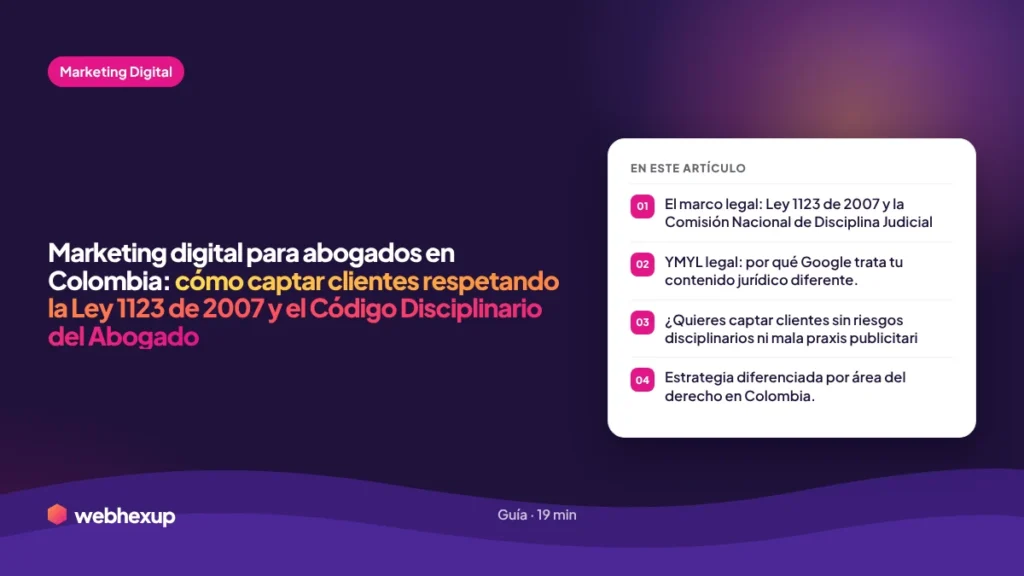
The legal framework: Law 1123 of 2007
and the National Judicial Disciplinary Commission.
Before discussing SEO, Google Ads, or LinkedIn, Colombian lawyers must understand their specific regulatory framework. The legal profession in Colombia is not regulated by voluntary recommendations from optional professional associations — it is regulated by the National Judicial Disciplinary Commission (CNDJ), the body that replaced the Superior Council of the Judiciary in disciplinary matters through Legislative Act 02 of 2015, with the authority to sanction lawyers who violate the Disciplinary Code.
Law 1123 of 2007 establishes the disciplinary regime for attorneys, including the ethical principles governing their practice and the offenses that may result in sanctions. The principles that apply directly to digital marketing are set forth in Article 28, which establishes the professional duties of attorneys, and in Article 32, which lists offenses against professional decorum. Among the relevant duties are: observing the ethical precepts of the profession, acting with loyalty and integrity, refraining from reckless conduct, and maintaining professional confidentiality. Offenses against professional decorum include: promoting oneself in a manner that offends professional decorum, promising results that do not depend exclusively on one’s own actions, and using misleading or inappropriate advertising.
Translated into concrete marketing terms, this means there are five practices that can trigger a disciplinary investigation by the CNDJ if carried out improperly. Unlike psychology, where ethical sanctions are well-documented, and accounting, where the JCC has sanctioned high-profile cases, disciplinary oversight in the legal profession is more active because lawyers are both users of the judicial system and subjects to that same system.
“We win 95% of our cases,” “I guarantee you’ll recover your assets,” “No win, no fee.” These statements violate the principle against promising outcomes that depend on factors beyond the lawyer’s control (judges, evidence, opposing counsel, changing laws). Article 33 of Law 1123 classifies as a violation the offering of services with guarantees that compromise the dignity of the profession. Procedural outcomes are never guaranteed—they depend on multiple variables beyond the lawyer’s control.
“Thanks to Attorney X, I got my foreclosed apartment back in 6 months,” “We won $150 million in a labor lawsuit against Company X.” These testimonials violate attorney-client privilege (they identify the client’s circumstances) and offer specific results as a promise. Permissible testimonials are generic in nature and focus on professionalism, clear communication, and respect—never on quantified outcomes of legal proceedings. A lawyer’s professional reputation is built on professional recognition, teaching experience, publications, and a verifiable track record.
“We’re the only serious firm in Bogotá,” “Other lawyers overcharge,” “Competitors who don’t deliver.” These statements violate the duties of respect and collaboration among colleagues established in the Disciplinary Code. Legitimate advertising communicates who you are and what you do—it is never built on disparaging other lawyers. The dignity of the profession must be upheld even in commercial advertising.
“Legal consultation for $29,900 this week,” “Express divorces: 50% off,” “Pay your inheritance taxes at a special price.” These phrases compromise the professional decorum required by Law 1123. Attorneys’ fees should be communicated with professional restraint, not as a retail promotion. Google Ads may also reject ads containing this type of aggressive commercial language for regulated professional services.
Advertising specifically targeting people in emotionally vulnerable situations—victims of recent accidents, individuals facing active legal proceedings, families in crisis. Ethical legal marketing recognizes that potential clients reach out during times of need and stress, and does not exploit that vulnerability with artificially urgent language. This aligns with the same ethical considerations that apply to digital marketing for psychologists.
What you can absolutely do: describe your professional credentials, academic background, areas of expertise, years of experience, teaching experience, academic publications, professional recognitions, and memberships in professional associations; and offer educational content on areas of law that informs without advising on specific cases. That is the territory where legitimate legal marketing is built and where the greatest opportunity for competitive differentiation lies.
Legal YMYL: Why Google Treats
Your Legal Content Differently.
YMYL stands for “Your Money or Your Life”—the category Google applies to sites whose content can impact people’s health, finances, safety, or legal rights. Legal content falls squarely into the YMYL category on two fronts: it can affect the reader’s legal rights (legal proceedings, contractual obligations, penalties) and it can affect their finances (fees, compensation, financial penalties). This has major SEO implications that most articles on legal marketing completely ignore.
The most important one: Google applies a higher standard of E-E-A-T (Experience, Expertise, Authoritativeness, Trust) to legal sites than to sites in most other sectors. A food blog can rank with generic articles written by freelancers without credentials; a family law blog cannot. Google actively verifies the author’s professional identity, looks for a verifiable professional license, evaluates the consistency of the entire site, and places specific weight on signals of authority that are secondary in other sectors.
In our study of 40 Colombian law firms, we found that 57.5% of the websites lack verifiable attorney bios and 75% lack a Schema Person. In an industry where credibility is literally the product, these are critical shortcomings. The E-E-A-T signals that will carry the most weight for Colombian lawyers in 2026 are: the professional’s full name with a visible professional license number on every article; an “About Me” page with specific academic credentials (university, year of graduation, specializations, master’s degrees, doctorates); a Schema Person configured with “sameAs” linking to LinkedIn and academic profiles, consistency between published content and the lawyer’s actual areas of practice, and citations of official Colombian sources (Civil Code, Penal Code, Substantive Labor Code, rulings from the Constitutional Court, Supreme Court, and Council of State) in technical articles.
A lawyer specializing in labor law who publishes articles on criminal law without specific training creates inconsistencies that Google detects. Publishing outside your actual area of expertise dilutes the site’s overall subject authority. Topic focus is a critical ranking factor in legal YMYL: 20 in-depth articles on a specialty where you truly have a demonstrable track record rank infinitely better than 50 superficial articles on 8 areas of law.
Another important consequence of YMYL: cited external sources matter more. In an article on severance pay, citing the Substantive Labor Code, Supreme Court rulings, established case law from the Council of State, and guidelines from the Ministry of Labor carries significant weight in rankings. Articles that cite regulatory sources with direct links consistently rank higher in legal content than those that offer opinions without references. This is consistent with Google’s official guidelines on useful content.
A tailored
strategy for each area of law in Colombia.
The most common mistake in marketing for lawyers is treating all areas of law as if they had the same business dynamics. They don’t. A criminal defense attorney and a corporate lawyer operate in completely different markets—different client profiles, different search channels, different decision-making cycles, and different case fees. Choosing a strategy without considering the practice area is a surefire way to waste your budget.
| Area of Law | Client Profile | Average Fee | Dominant Channel |
|---|---|---|---|
| Criminal | Clients in Active Litigation | $3M – $50M per case | Google Ads for urgent cases + local SEO |
| Family | Individuals going through emotional challenges (divorces, custody battles) | $2M – $15M per case | Local SEO + Google Ads |
| Employment (employees) | Workers whose rights have been violated | $1M – $8M per case | Local SEO + social media |
| Labor (companies) | HR and managers at small and medium-sized businesses | $3M – $20M monthly retainer | LinkedIn + B2B content |
| Civil / Contractual | SMEs and business owners | $2M – $25M per case | Technical SEO + LinkedIn |
| Tax | High-net-worth individuals, SMEs, corporations | $5M – $80M per case | LinkedIn + specialized content |
| Corporate / M&A | Management of medium-sized/large companies | $20M – $500M+ per project | Networking + LinkedIn + referrals |
| Immigration | Individuals in the immigration process | $1M – $10M per case | SEO + Google Ads + social media |
For high-urgency B2C areas such as criminal, family, or employment law, the dominant channel is SEO combined with Google Ads. These are searches where the decision to hire a lawyer is made within hours or days—the person needs a lawyer right away. For B2B areas such as corporate labor law, corporate law, tax law, or intellectual property, the decision takes weeks or months and involves multiple stakeholders—the dominant channel is LinkedIn with specialized content, strategic networking, and qualified referrals.
A criminal defense attorney in Bogotá or Medellín who doesn’t invest in Google Ads is leaving revenue on the table—searches like “urgent criminal defense attorney” have high commercial intent, and CPCs, though high, yield a predictable return. A corporate lawyer specializing in M&A who invests in Google Ads is wasting their budget—their clients don’t come through search; they come through referrals from other corporate lawyers, industry conferences, and a strong LinkedIn presence with in-depth technical content.
The
lawyer’s personal brand vs. the law firm’s brand.
This is the most important strategic decision a lawyer makes when entering digital marketing, and most make it by default without analyzing it. Building a lawyer’s personal brand is a different strategy from building a law firm’s brand—each has implications for SEO, content, distribution, and business succession.
Lawyer’s Personal Brand
Works best for: independent attorneys, senior partners at small firms, specialists who leverage their academic reputation, and professionals in the early stages of their individual careers. Advantages: positioning as an industry leader, faster authority-building, greater flexibility when changing firms, and better return on investment on LinkedIn. Disadvantages: The asset belongs to the individual professional; it cannot be transferred or sold, and it does not scale beyond the individual’s capacity. A lawyer with a strong personal brand can bill significantly more per hour—their value lies in the person, not the structure.
Law Firm Brand
Works best for: established firms with multiple partners, firms planning to grow by hiring new professionals, structured succession plans, and B2B firms with corporate clients who prefer to hire “the firm” rather than “the attorney.” Advantages: transferable asset, scales with team growth, greater resilience to turnover, better corporate positioning. Disadvantages: slower build-up of authority, requires sustained investment in branding, less flexibility on LinkedIn.
The decision depends on the business model, not the lawyer’s personal preference. Small firms aiming to grow must build a firm brand from the start—it is not efficient to first build the founding partner’s personal brand and then try to transfer it to the firm. Lawyers who want to maintain an individual practice as a signature asset should focus 80% of their investment on their personal brand and 20% on their professional website.
A hybrid model that works well: firms with a strong institutional brand where senior partners maintain complementary personal brands in their areas of expertise. This is seen in firms such as Brigard Urrutia, Posse Herrera Ruiz, or Philippi Prietocarrizosa, where the firm has an established presence but specific partners maintain individual visibility in their areas of expertise. This model can be replicated on a smaller scale in mid-sized Colombian firms—and this is exactly what firms like Cafore Abogados (Bogotá) and Chaux Jaramillo (Cali) do well; we identified them as benchmarks in our technical study of 40 Colombian firms.
Digital
Channels by Client Type.
Each area of law has dominant digital channels. Choosing a channel without considering your specialty is the main reason why many lawyers invest in marketing and see no return. These are the most effective channels by client type.
Local SEO + Google Business Profile (urgent for B2C)
Local SEO is the channel with the best return on investment for B2C lawyers with a physical office—criminal defense, family law, employment law, traffic law, and immigration law. Searches such as “criminal defense attorney in Chapinero,” “family law attorney in El Poblado,” and “employment law attorney near me” have high commercial intent and moderate competition in most Colombian cities. With a properly configured Google Business Profile and a consistent local SEO strategy, a lawyer can generate between 8 and 30 qualified inquiries per month without investing in paid advertising.
Properly setting up a Google Business Profile requires specific decisions. The primary category should be “Lawyer” or “Law Firm,” as appropriate—never “Legal Advisor” or “Generic Legal Services”—broad categories that dilute visibility in specific searches. Secondary categories should reflect actual areas of practice: “Criminal Defense Attorney,” “Family Law Attorney,” or “Immigration Attorney” when applicable and backed by a proven track record.
Google Ads (High Urgency B2C)
For criminal, family, employment, immigration, and traffic law, Google Ads delivers immediate returns. CPCs are high (some legal keywords exceed 20,000 COP per click), but the revenue per closed case justifies the investment. Geographic targeting by specific neighborhoods, strategic scheduling (criminal law searches increase between 10 PM and 2 AM), and direct call extensions are critical levers that most firms do not use effectively.
LinkedIn + Technical Content (B2B)
For corporate, tax, intellectual property, and employment law, LinkedIn is the dominant channel. Legal managers, HR professionals at SMEs, and owners of medium-sized companies research lawyers on LinkedIn before reaching out—they review profiles, read posts, and verify professional backgrounds. A B2B attorney without a content strategy on LinkedIn is practically invisible to potential clients. Effective content is technical, specific to the practice area, and provides real value without publicly advising on specific cases.
Visibility on AI Platforms (AEO/GEO)
More and more people are asking ChatGPT, Perplexity, or Gemini, “Which lawyer do you recommend for X in Y city?” before searching on Google. In our study of 40 Colombian law firms, we found that none have a comprehensive GEO strategy—this is an open competitive window. Lawyers who conduct AI visibility audits and AEO optimization by 2026 can position themselves as a cited reference before the market becomes saturated.
The 6 Most Costly
Marketing Mistakes for Colombian Lawyers.
Most legal marketing content in Spanish comes from Spain or Argentina. The articles discuss the Spanish Code of Professional Conduct for Lawyers, the Argentine Provincial Bar Associations, prices in euros, and processes that do not exist in Colombia. Copying these strategies is dangerous because you could unknowingly violate Colombia’s disciplinary framework and miss out on opportunities specific to the local market. Before adopting any tactic, verify that it complies with Colombia’s regulatory framework.
“We win 95% of our cases,” “I guarantee you’ll recoup your investment,” “No win, no fee.” These promises directly violate the Attorney Disciplinary Code and may trigger an investigation by the CNDJ. Additionally, Google Ads and Meta Ads are increasingly rejecting ads with these types of guarantees in regulated sectors. Professional advertising communicates expertise and methodology, never specific results that depend on external factors.
This is the most common mistake and the one that most significantly impacts YMYL in the legal field. A lawyer’s website that lacks a full name, bar license number, academic credentials, universities attended, and a verifiable track record will not pass Google’s E-E-A-T filter. In the study of 40 law firms we published, 57.5% had this critical gap. The “About Me” page isn’t just for show—it’s the most-visited page before any consultation.
Law firm websites that offer “criminal, civil, labor, family, commercial, administrative, tax, immigration, traffic, and constitutional law” are the types that Google ranks the lowest. A lack of specialization dilutes subject matter authority and creates inconsistencies in E-E-A-T. Worse yet: publishing articles on areas where you have no actual experience is an act beyond your scope of practice that can compromise professional liability. The winning strategy is a maximum of 2–3 areas, covered in depth with substantive content.
It’s tempting when someone publicly asks on Instagram or Facebook, “What should I do if my employer won’t pay me my severance pay?” and, as a lawyer, you want to help. But responding with specific legal advice on social media poses three problems: you can’t assess the full scope of the case based on public information; you compromise your professional liability by giving advice without a formal attorney-client relationship; and it can be viewed as an improper practice of law. Educational content explains rights in the abstract; specific advice is provided during a formal consultation.
More and more people are asking ChatGPT, Perplexity, or Gemini, “Which lawyer do you recommend for X in Y city?” before searching on Google. Lawyers who aren’t optimized to be cited by language models are missing out on a layer of visibility that grows month by month. AEO/GEO optimization is a specific technical task that ties into traditional SEO but follows its own logic. Our guide on AI visibility auditing details the applicable methodology.
Legal marketing by city:
the Colombian context.
📍 Medellín · Valle de Aburrá
Medellín sees high demand for legal services in El Poblado, Envigado, Laureles, and Ciudad del Río. In our audit of 40 firms, Cuadro Legal emerged as the technical benchmark for hreflang ES/EN, Villegas Consultores as the E-E-A-T benchmark for academic bios, and Derecho & Equidad as the first site to implement FAQPage. SEO competition is moderate in specific practice areas. Our SEO agency in Medellín works with local legal professionals and firms.
📍 Bogotá · Capital Region
Bogotá has the largest concentration of lawyers in the country and the fiercest competition in both SEO and paid advertising. Large firms (Brigard Urrutia, PHR Legal, Dentons Cárdenas & Cárdenas, Posse Herrera, Philippi Prietocarrizosa) set the bar with ES/EN hreflang tags, Chambers and Partners rankings, and international recognition. Cafore Abogados stands out as the benchmark for mid-sized firms specializing in executive law. Our SEO agency in Bogotá tailors its strategy to each subregion and practice area.
📍 Cali · Barranquilla · Mid-sized cities
In Cali, Chaux Jaramillo Abogados is the national benchmark with FAQPage Schema, an active blog featuring 6 categories, and AEO-ready content—one of the few sites optimized for AI Overviews in the Colombian legal sector. Barranquilla is the market with the greatest opportunity for the firm: only 146 firms listed in the directory compared to 813 in Bogotá, and almost no genuine local content. We handle SEO in Colombia across all mid-sized cities.
Frequently asked questions about
digital marketing for lawyers.
As a lawyer in Colombia, can I publish client testimonials?
Yes, but with strict limitations. General testimonials regarding professionalism, clear communication, and support throughout the process are acceptable with written authorization. Testimonials containing specific case details (quantified results, amounts recovered, specific timelines) violate attorney-client privilege and may lead to a disciplinary investigation by the CNDJ. The recommendation is to use generic testimonials without specific results, with documented authorization and without information that could identify the client’s circumstances.
How much should a lawyer invest in digital marketing?
It depends on the practice area, the sales cycle, and the average revenue per client. As a general guideline in Colombia, an independent attorney with an established practice typically invests between 6% and 12% of their monthly income in digital marketing. Mid-sized firms with several professionals may require larger budgets, especially if they operate in B2B areas where LinkedIn and specialized content are the main drivers. In a study of 40 firms, average investment ranges were between $1.5M and $5M per month for comprehensive SEO and advertising strategies.
How long does it take for SEO to attract real clients for a lawyer?
In mid-sized cities with moderate SEO competition, a lawyer can see the first results in qualified organic traffic within 3–6 months with consistent technical and content efforts. In Bogotá and Medellín, the typical timeframe is 6–12 months, depending on the practice area—criminal and family law rank faster than corporate or tax law, where competition is very high. Local SEO using Google Business Profile can generate inquiries in 2–4 months.
Does Google Ads work for lawyers in Colombia?
Yes, especially in high-urgency B2C areas—criminal law, family law, employee labor law, immigration, traffic law, and personal injury. CPCs are high (for some legal keywords, they can exceed 20,000 COP per click), but the return per closed case justifies the investment. For B2B areas such as corporate, tax, or intellectual property law, Google Ads offers a lower return—the decision-making process for hiring a lawyer is longer and more complex. The recommendation is to tailor the channel to your practice area.
Is LinkedIn effective for attracting clients as a lawyer?
Yes, especially for B2B segments. LinkedIn is the dominant channel for legal hiring decisions in companies—legal managers, HR professionals at SMEs, and owners of medium-sized businesses research lawyers on LinkedIn before making contact. For B2C lawyers (family, criminal, and employment law), the return on LinkedIn is low—Google dominates in these areas. The recommendation is to tailor the channel to the target segment.
How do I appear in ChatGPT or Perplexity when people search for a lawyer in my specialty?
Language models cite sites with clear subject authority, verifiable credentials, and a solid technical structure. To appear when someone searches for “criminal defense attorney in Medellín” or “tax firm in Bogotá,” your site must have in-depth content on your specialty, an “About Me” page with a professional profile and complete credentials, a configured “Person” schema, and specific AEO/GEO optimization. In our study of 40 Colombian firms, we found that zero sites have a complete GEO strategy—this represents a real competitive opportunity for lawyers who work on this optimization in 2026.
How much does Webhexup’s marketing service for lawyers cost?
Services are organized into plans based on the size of your practice, your area of legal specialization, competition in your city, and your growth objectives. We offer a free initial audit where we evaluate your specific case using the same methodology as in our technical study of 40 firms. General price ranges can be found on our pricing page, and the specific proposal is tailored to your professional profile and the applicable regulatory framework.