
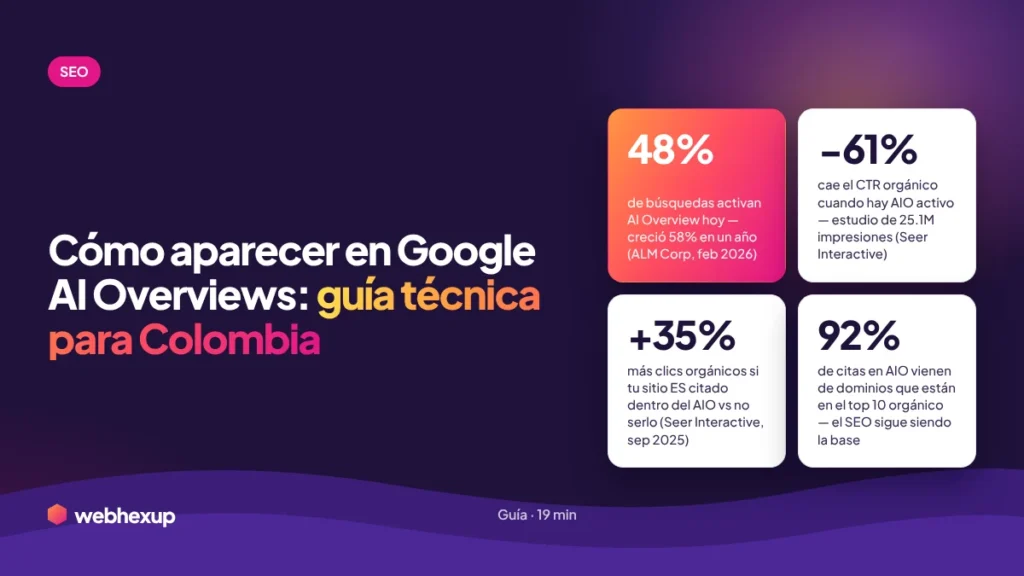
As of February 2026, Google’s AI Overviews already appear in 48% of all tracked searches—and when they do, the CTR of the top organic result drops by between 34.5% and 61%, depending on which study you look at. But there’s a side to this story that nobody tells you: sites cited within the AI Overview receive 35% more organic clicks and 91% more paid clicks. The difference between being a source and not being one has never been greater.
In the past, ranking in the top 3 guaranteed traffic. Today, being in the top 3 without being cited in the AIO can mean less traffic than being in position 8 two years ago. The metric that matters is no longer just the ranking.
Being mentioned in an AI Overview generates a 91% increase in clicks on Google Ads for that same brand. Users see your name in Google’s answer, recognize the brand, and click on the ad. The AIO acts as high-visibility brand validation.
Healthcare (88% activation rate), education (83%), and professional services are the most prominent sectors in Colombia. Transactional searches are relatively protected—only 4% trigger an AIO.
I’ve been in SEO for nearly 20 years. I’ve seen Penguin, Panda, Hummingbird, RankBrain, and BERT come along. None of those changes altered the fundamental mechanics of search: the user types, Google shows ten links, the user clicks. AI Overviews are disrupting that process for the first time in 25 years. This guide explains exactly what to do about it—using real data from the nine most rigorous studies published through April 2026.
If you want to first understand the entire AI visibility ecosystem, start with our article on GEO, AEO, and AIO in 2026. If you already understand the big picture and want the technical action plan, keep reading.
What are Google AI Overviews
and why are they changing 25 years of search?
An AI Overview is a block of text generated by artificial intelligence that appears at the top of Google’s SERP—before the first ad, before the number-one organic result—and answers the user’s question directly, without requiring them to click on any website. Google synthesizes information from multiple sources and presents the answer with short quotes linked to the source sites.
They began as “Search Generative Experience” (SGE) in 2024 and became AI Overviews starting in May of that year. By February 2026, they appeared in 48% of all tracked searches—a 58% year-over-year increase. In Colombia, the exact data hasn’t been published, but based on my own Search Console and those of my clients in Medellín, Bogotá, and Cali, the pattern is unmistakable: informational searches in Spanish are being absorbed.
What struck me most when analyzing the data isn’t the drop in CTR—it’s the mirror effect on ad performance. When a brand is mentioned in an AI Overview, its clicks on Google Ads increase by 91%. Users see your name in the answer, recognize the brand, look for more information, and end up clicking on the ad. AI Overviews become high-visibility brand validation for those featured in them.
The actual CTR data:
what the 9 most rigorous studies say.
I’ve reviewed the 9 most credible studies published between 2024 and 2026. The unfiltered numbers:
| Study | Sample | Organic CTR Drop | Key Additional Data |
|---|---|---|---|
| Seer Interactive (Sept. 2025) | 3,119 queries · 25.1M impressions | −61% (from 1.76% to 0.61%) | Cited in AIO: +35% organic clicks, +91% paid clicks |
| Ahrefs (Dec 2025) | 300,000 keywords | −58% for position #1 | The largest study by keyword volume |
| Pew Research Center (Mar 2025) | 68,000 queries · 900 real users | −46.7% (8% vs. 15% without AIO) | Methodologically the most rigorous — real browsing data |
| Amsive Digital (2025) | 700,000 keywords | −15.49% on average | The lowest range because it includes all types of queries |
| Authoritas (2025) | Multiple industries | −79% for link #1 | 70% of cited pages change every 2–3 months |
| Search Engine Journal (2026) | 10M+ keywords | From 28% to 19% for #1 | Sustained absolute decline in organic top CTR |
| SparkToro / The Digital Bloom (2025) | All Google searches | 60% zero-click | Rises to 93% when Google AI Mode is active |
| Gartner (2026 projection) | Market Analysis | −25% projected total organic traffic | 25% of traffic will shift to chatbots and voice |
| ALM Corp / BrightEdge (Feb. 2026) | Queries tracked globally | — | AIO in 48% of searches. Grew 58% YoY. Healthcare leads with 88% |
Why studies range from −15% to −79%: each measures something different. Some measure average CTR for all positions, others only for position #1, and others only for informational queries. The one thing they all agree on: they all show a decline. Without exception. And they all confirm that being cited reverses that trend.
What types of searches trigger
an AI Overview in Colombia.
Not all searches trigger an AI Overview. Understanding which ones do determines where you should optimize first. According to BrightEdge data tracked between February 2025 and February 2026:
| Sector / Search Type | % that triggers AIO | Impact in Colombia |
|---|---|---|
| Health and medical information | 88% | Clinics, doctors, psychologists, nutritionists — high urgency |
| Education and academia | 83% | Universities, high schools, e-learning platforms — high priority |
| B2B Technology and SaaS | 82% | Software, tech agencies, digital consulting — high priority |
| Finance and insurance | ~75% | Accountants, insurance companies, tax advisory firms — high urgency |
| General informational ("how," "what is," "how much") | 39.4% | Guides, tutorials — significant impact across all sectors |
| Legal and government | ~35% | Lawyers, administrative procedures, Colombian regulations |
| Travel and tourism | ~30% | Hotels, destinations, restaurants — medium urgency |
| Transactional (“buy X,” “price of Y”) | ~5–8% | E-commerce is relatively protected for now |
| E-commerce / specific product | 4% | Less direct impact on online stores |
| Navigational (direct brand searches) | <2% | Your direct brand is safe |
If you have a clinic, medical practice, accounting firm, or educational institution in Colombia, over 80% of the searches that bring you new customers are already being intercepted by AI Overviews. If you have an online store selling specific products, the impact is much smaller today—but the informational content on your blog is vulnerable.
How Google selects its sources
for AI Overviews.
Google has not published a technical paper explaining the exact selection algorithm. What does exist are statistical patterns derived from studies. Here’s what can be stated with data to back it up:
- Organic Top 10: 92.36% of citations come from the top 10. It’s not impossible to rank from lower positions, but this is the prevailing rule
- High domain authority: High-traffic sites receive 3× more citations (SE Ranking, 2025)
- Fresh content: Pages not updated quarterly are 3× more likely to lose their citation (Semrush)
- Reviews on external platforms: 3× more likely with active profiles on G2, Capterra, Trustpilot, or GBP
- Real-world E-E-A-T: Pages with firsthand data are cited 3.2× more often (AI Labs Audit, Mar 2026)
70% of pages cited in AI Overviews change every 2–3 months (Authoritas, 2025). Being cited in an AIO is not a permanent achievement—it’s a dynamic state.
A site cited today may no longer be cited if it fails to maintain quality and freshness. Optimizing for AIO requires ongoing maintenance, not a one-time setup.
Step 1 — An unbreakable
technical SEO foundation is the prerequisite for everything else.
An AI Overview will never cite a page that Google has difficulty crawling, indexing, or loading quickly. This is the step where most Colombian sites fail before even reaching the next ones.
Core Web Vitals passed in the field
LCP < 2.5s, INP < 200ms, CLS < 0.1. Measure them in PageSpeed Insights and in GSC → Experience → Core Web Vitals (field data, not lab data). On WordPress running on Hostinger LiteSpeed, you can achieve a score of 90+ on mobile with the correct configuration. Our technical SEO service covers this fundamental aspect.
Clean Indexing Without Cannibalization
Verify that every target URL is indexed in GSC → Coverage. Use site:tudominio.com to audit. Remove unnecessary URL parameters and use canonical tags where there is similar content. Duplicate content confuses the algorithm: Google doesn’t know which version to rank.
Clear information architecture
Descriptive URLs (/como-aparecer-google-ai-overviews-colombia/, not /?p=4312). XML sitemap updated and submitted in GSC. Breadcrumbs in visible HTML and in Schema BreadcrumbList. A clear architecture helps the models understand the domain’s topic hierarchy.
HTTPS without mixed content
100% of the site is on HTTPS. Verify with SSL Labs. Active HTTPS is a sign of trust for both the ranking algorithm and the models that select sources—the “T” in E-E-A-T (Trustworthiness) is directly affected by an insecure site.
Step 2 — AEO
Content Structure: How to Write So AI Will Cite You.
AEO (Answer Engine Optimization) is the practice of structuring content so that Google AI Overviews, ChatGPT, Perplexity, and Gemini can easily extract and synthesize it. It doesn’t replace SEO—it complements it. 44.2% of citations in LLMs come from the first 30% of the text (Growth Memo). Write the most important information first.
Direct answer within the first 100 words
The model either extracts the answer from the first few paragraphs or doesn’t extract it at all. Don’t build suspense—answer first, then explain in depth. This article follows that rule: the definition of AI Overviews appears in the second visible paragraph, not at the end of a 400-word introduction.
H2/H3 Headings in Question Format
Instead of “Selection Factors,” write “What factors does Google use to select sources in AI Overviews?” Models look for question-answer pairs. Question-formatted headings also appear in “People Also Ask”—they boost organic CTR while optimizing for AIO.
Short paragraphs: 3–4 sentences maximum
Models process short blocks more accurately. An 8-sentence paragraph is difficult to extract without losing semantic context. Short paragraphs allow the model to quote the entire block faithfully. Never put two different ideas in the same paragraph if you can avoid it.
LLM Summary Block at the Beginning of the Article
A block that summarizes the entire page’s content in 3–5 sentences, written in the exact language an LLM would use to quote you. Call it “Executive Summary” or “What You Need to Know.” It’s the section with the highest density of useful information per unit of text—the easiest to quote.
At least 5 FAQs per article with 40–80-word answers
FAQs are the format that most directly feeds AI Overviews. Each question should be a real search query someone would enter into Google. Each answer should be between 40 and 80 words: long enough to be complete, short enough to be extractable. Implemented using HTML microdata—never manual JSON-LD if you’re using Yoast.
Step 3 — Correct
Schema Markup: the golden rule with Yoast SEO.
For WordPress posts using Yoast SEO, there’s one rule that’s frequently broken and ruins all your work:
⚠ Golden rule with Yoast SEO Free: NEVER add manual JSON-LD with FAQPage. Yoast already automatically generates Article + BreadcrumbList + Person within its @graph. If you add another JSON-LD block, Google sees two Schema blocks and may ignore both. The correct solution: FAQPage in HTML microdata directly within the article content.
<div itemscope itemtype="https://schema.org/FAQPage">

  <div itemscope itemprop="mainEntity"
       itemtype="https://schema.org/Question">
    <h3 itemprop="name">
      ¿Qué son los Google AI Overviews?
    </h3>
    <div itemscope itemprop="acceptedAnswer"
         itemtype="https://schema.org/Answer">
      <p itemprop="text">
        Los Google AI Overviews son resúmenes generados
        por inteligencia artificial que aparecen en la
        parte superior del SERP antes de los resultados
        orgánicos. Google los genera sintetizando
        información de múltiples fuentes web.
      </p>
    </div>
  </div>

  <!-- Repite el bloque para cada pregunta -->

</div>
| Page type | Recommended Schema | Impact on AIO |
|---|---|---|
| Blog post / guide | Article (Yoast auto) + FAQPage microdata + BreadcrumbList | High — structures the response directly |
| Service page | Service + FAQPage microdata + BreadcrumbList | High — in service searches |
| Author/Team Page | Person + Profile Page | High for E-E-A-T in authorship |
| Local business (clinic, restaurant) | LocalBusiness + OpeningHours + GeoCoordinates | Very high in local searches |
| Step-by-Step Guide | HowTo + Step | High — AIO can display directions |
| E-commerce / Product | Product + Aggregate Rating + Offer | Medium-Low — AIO rarely appears in transactional content |
Step 4 — Verifiable
E-E-A-T signals: real-world experience, not well-written theory.
E-E-A-T: Experience, Expertise, Authority, and Trust. Google confirmed that AI Overviews use the same quality systems as organic ranking. The newest and most critical component is the first E: Experience. Pages that demonstrate real-world practice are cited 3.2× more often than those that merely theorize (AI Labs Audit, March 2026).
- Authentic author page: URL like
/autor/jose-fernando/with a photo, a 150+ word bio, verifiable credentials, and an active LinkedIn profile - Original data in each article: real GSC screenshots, client results (with permission), verifiable figures
- Visible publication and update dates: in HTML and in Schema dateModified
- Citations from authoritative sources: link to Seer Interactive studies, official Google documentation, industry publications
- Updated privacy policy and Terms & Conditions linked from the footer
- Real contact information: verifiable physical address, phone number, direct email—not just a contact form
- Active reviews on Google Business Profile (GBP) and external platforms: Clutch, Sortlist, Trustpilot, or industry directories
- Backlinks from Colombian media outlets: mentions in La República, Portafolio, or industry publications. Difficult but extremely valuable for establishing authority in Spanish
Step 5 — Topic authority and clusters
: the context that proves to Google that you’re the go-to source.
A single, well-optimized article has a low probability of being cited in AIO. A site with 15 interconnected articles on the same topic, featuring a central pillar page and strategic internal linking, has a much higher probability. Google evaluates the domain’s topic depth, not just the quality of a single page.
Pillar page — the central hub of the topic
A page that covers all aspects of a broad topic without delving deeply into any specific one. Example: “What Is SEO in Colombia?” Its purpose is to map out the entire landscape and link to supporting articles. It can be a service page or a very comprehensive article.
Supporting Articles — In-Depth Coverage of Subtopics
Each article covers a subtopic in depth and links back to the pillar page. Within Webhexup’s SEO cluster: keyword research, technical WordPress SEO, link building, Core Web Vitals. They all link to each other and to the pillar page.
Strategic internal linking with descriptive anchor text
Never use “click here” as anchor text. Use the topic’s name: “our step-by-step SEO audit guide.” Each article should link to 3–4 articles from the same cluster. This semantic network helps Google assess the domain’s depth on the topic.
Quarterly update of the entire cluster
70% of AIO citations change every 2–3 months. A quarterly update strategy maintains the freshness that Google prioritizes. You don’t need to rewrite—just update data, add new examples, review links, and update the `dateModified` property in Schema. The cost is low; the benefit in citation retention is high.
How to measure your visibility in AI Overviews
using Google Search Console.
Google doesn’t yet have a dedicated report for AI Overviews in GSC. Measurement is indirect but effective if you know what to look for. Here are the three methods I use with my clients:
Method 1 — Detect the AIO effect on your current keywords
In GSC → Performance → Searches, filter by informational keywords (those containing “how,” “what is,” “how much”). Compare impressions vs. clicks over the last 6 months with the previous period. If impressions go up but clicks go down—that keyword is being taken over by an AI Overview. This difference between impressions and clicks is your indicator of the actual impact.
Method 2 — Weekly Manual Test
Once a week, manually search for your 10–15 most important keywords in an incognito window in Chrome. Note how many trigger the AI Overview and whether your site is mentioned. It’s time-consuming but provides 100% certainty about what Google is showing your actual users.
Method 3 — Specialized Tools
Semrush has added an AIO layer to its Position Tracking feature. Sistrix provides data on frequency and competitors cited by keyword. Ahrefs is in beta with modules to track which domains appear in AIO. For most Colombian businesses, the manual method combined with GSC is sufficient and free while these tools continue to mature.
Which sectors in Colombia most need
to optimize for AI Overviews right now.
- Clinics and doctors — 88% adoption rate
- Psychologists and therapists
- Lawyers and law firms
- Accountants and tax advisors
- Universities and colleges — 83%
- Insurance agencies
- Real estate agencies and construction companies
- Hotels and tourism
- Restaurants
- Consultants and coaches
- Marketing agencies
- Gyms and fitness centers
- E-commerce for physical products
- Stores with a strong brand
- B2B manufacturing
- Wholesale distributors
Implementation Checklist:
25 Points to Get Ready.
This is the exact checklist I use when auditing a Colombian website to prepare it for AI Overviews. Five categories, five points each:
🔧 A. Technical Foundation
✍️ B. AEO Structure
📐 C. Schema Markup
👤 D. E-E-A-T
🔗 E. Topic Authority
Frequently asked questions about
Google AI Overviews in Colombia.
Can I ask Google to include my site in the AI Overviews?
There is no mechanism to request inclusion in AI Overviews. Selection is 100% algorithmic and automatic. What you can do is optimize the factors that increase the likelihood of inclusion: a solid technical foundation, content structured with AEO, correct Schema Markup, verifiable E-E-A-T signals, and subject-matter authority built through interconnected content clusters.
Are Google AI Overviews available in Colombia?
Yes. From my own Search Console and those of my clients in Colombia, I can clearly see the effect: impressions are rising, but clicks are falling for informational searches. Google confirmed the rollout in multiple Spanish-speaking countries throughout 2025. In Medellín, Bogotá, and Cali, there is already direct evidence in sectors such as healthcare, law, and education.
How long does it take to see results from optimizing for AI Overviews?
Basic technical implementation—Schema, speed, AEO structure—can show results within 30–45 days (AI Labs Audit). Building E-E-A-T and subject matter authority is a process that takes several months. An early positive sign is seeing the content cited in sector-specific long-tail searches within the first 6–8 weeks of successful implementation.
Can AI-generated content appear in AI Overviews?
Technically, yes, if it meets the quality criteria. The paradox: AI Overviews prioritize signals of real-world experience—firsthand data, real-life examples, and firsthand perspective. Content generated purely by AI tends to be generic and has fewer signals of real-world experience. AI-assisted content with extensive human editing and verifiable firsthand data can perform very well.
What’s the difference between AEO, GEO, and traditional SEO?
Traditional SEO optimizes for ranking in search results with blue links. AEO (Answer Engine Optimization) structures content so that answer engines—Google AI Overviews, ChatGPT, Perplexity—can extract and cite it. GEO (Generative Engine Optimization) is the broader term that includes building entity authority for generative engines. At Webhexup, we treat them as a single discipline integrated into SEO.
Do online stores in Colombia need to optimize for AI Overviews?
To a lesser extent than other sectors. Transactional searches trigger AI Overviews only 4–8% of the time. The key exception: informational e-commerce pages—buying guides, comparison charts, “how-to-choose” guides—are indeed vulnerable. An online store with an informational blog should optimize that content for AIO even if its product pages are relatively protected.
Visibility in AI Overviews
by city in Colombia.
📍 Medellín
In Medellín, searches for cosmetic medicine, psychology, gastronomy, and digital marketing already show active AI Overviews in Spanish. Businesses in El Poblado, Laureles, and El Centro without an AEO structure are losing visibility to competitors with less experience but better-structured content. At our Medellín SEO agency, we focus on the specific Colombian context.
📍 Bogotá
Bogotá has the highest volume of informational searches in the country in the legal, financial, and educational sectors—those most exposed to AI Overviews. A law firm or consulting firm without an AEO is already at a disadvantage. Our Bogotá SEO agency handles projects in the district. The Bogotá market is the first where the impact of AI Overviews will be felt most rapidly.
📍 Cali · Barranquilla · Bucaramanga · Mid-sized Cities
In mid-sized cities, SEO competition is lower, but the adoption of AI Overviews is advancing at the same pace. A business that optimizes for AIO in Bucaramanga or Pereira today has a 6- to 12-month window before its local competitors do the same. Our SEO agency in Colombia works on projects throughout the country.