


Ask ChatGPT right now: “What are the best companies in [your industry] in [your city]?” The answer you get is, literally, what your potential customers are reading when they do their research before hiring. If your brand doesn’t show up, it’s not because you’re doing a bad job—it’s because no one optimized your site so that language models would mention you. An AI visibility audit is the first step toward fixing this. This article details the exact methodology we use.
The technical context is simple: according to aggregated data from Gartner and Semrush cited by GEO industry references in 2026, more than 40% of searches include some AI component, and global organic traffic has fallen significantly over the past year because users are getting direct answers without clicking. If your digital strategy relies exclusively on traditional SEO, you’re missing out on an entire layer of visibility—the layer where language models act as intermediary filters between the user and your brand.
The question is no longer whether you should conduct an AI visibility audit—it’s when you’ll do it and using what methodology. This article documents the actual process we apply at Webhexup, step by step, without any secret proprietary tools or black boxes. Methodological transparency is what sets a professional audit apart from a generic, automated report.
What an
AI visibility audit really is.
There is a lot of confusion about what “auditing AI visibility” means because the term is used for very different things. Before diving into the methodology, it’s worth establishing what a professional audit is—and what it isn’t.
A professional AI visibility audit is a systematic process that uses structured prompts and repeatable tests to measure how your brand appears in the leading AI-powered response engines when a user makes queries related to your industry, your services, or your products. It is not a one-off query or an automated report on “how many times you appear.” It is a technical assessment featuring a set of industry-specific prompts, an evaluation of the quality and sentiment of mentions, an analysis of the sources the models are using to generate responses about you, and a direct comparison with your most relevant competitors.
What distinguishes a thorough audit from an automated report is industry-specific contextualization. Tools like Ahrefs Brand Radar or free checkers provide raw data—how many mentions, on which platforms, and with what overall sentiment. That’s 30% of the work. The remaining 70% is understanding what that data means for your specific business in Colombia, how relevant each mention is compared to your audience’s actual purchase intent, and what technical and content levers you can pull to systematically improve.
A well-executed audit answers three practical questions that no automated dashboard can answer on its own: First, how much qualified traffic are you losing because AI tools are making you invisible? Second, what concrete actions should you take in the next 90 days to make a difference? Third, how can you measure progress without relying on a single platform that could change tomorrow?
The 5 main
drivers and how each one performs.
A common mistake in superficial audits is treating all AI engines as if they were the same. They’re not. Each platform has distinct patterns for retrieving, citing, and prioritizing sources. Optimizing for ChatGPT doesn’t automatically mean optimizing for Perplexity or Gemini. Understanding these differences is critical for designing platform-specific strategies.
ChatGPT (OpenAI)
ChatGPT combines statically trained knowledge with real-time retrieval through its web browsing feature (ChatGPT Search). The mentions that appear when you ask about specific brands depend heavily on the training cutoff date and the domain’s accumulated authority. It tends to provide more narrative-based and less link-heavy responses than Perplexity. In Colombia 2026, ChatGPT is partially replacing traditional searches, especially among professional B2B and technical audiences.
Perplexity
Perplexity is the most transparent response engine in terms of its citations—each response includes numbered sources with direct links. It prioritizes recent, well-structured content with appropriate schema markup. For AEO strategies, Perplexity is the engine where the results of technical optimization are most visible in the short term. If you publish new, well-structured content about your industry, Perplexity considers it a potential source much faster than ChatGPT or Gemini.
Gemini and Google AI Overviews
Gemini (Google’s AI) and the AI Overviews that appear in Google search results are related but not identical systems. AI Overviews have significant overlap with traditional organic ranking—sites that already rank well in SEO are more likely to be cited in AI Overviews. Gemini, as a standalone product, follows similar but not identical patterns. Both prioritize E-E-A-T signals, structured schema, and thematic consistency within the domain.
Claude (Anthropic)
Claude exhibits more conservative behavior when it comes to brand-specific citations. When asked for recommendations in a particular sector, it tends to provide more conceptual explanations and fewer lists of specific options than other engines. For auditing purposes, Claude is valuable because it reveals what aggregated information it has about your sector—which is useful for understanding how your industry is described in general before delving into specific brands.
Copilot (Microsoft)
Copilot integrates OpenAI’s GPT-4 with Bing results. Its citations behave similarly to ChatGPT but place greater emphasis on Bing results—which, in turn, use ranking algorithms different from Google’s. In markets where Bing has a significant share (corporate Windows users, specific B2B segments), Copilot provides an additional layer of visibility that cannot be ignored.
| Engine | Citation Pattern | Top Priorities | Ease of Optimization |
|---|---|---|---|
| ChatGPT | Narrative, few sources | Accumulated domain authority | Average |
| Perplexity | Transparent, numbered sources | Recent content + schema | High |
| Gemini / AI Overviews | Synthetic with links | Traditional SEO ranking + E-E-A-T | Medium-high |
| Claude | Conceptual, conservative | Semantic context of the industry | Medium |
| Copilot | Narrative with links Bing | Bing SEO + authority | Media |
Webhexup’s step-by-step
audit methodology.
This is the actual methodology we apply in every AI visibility audit, publicly documented. We publish it because we believe methodological transparency is the most honest way for a potential client to understand what they’ll receive and compare proposals objectively.
Phase 1: Strategic Mapping (1–2 days)
Before running a single prompt, we do the strategic groundwork to understand your business. We identify your 3–5 actual direct competitors (not the ones you think they are—the ones the market treats as such). We map out your 8–15 most important services or products using the language your actual customers use, not internal jargon. We define the 4–7 high-commercial-value queries a potential customer would ask an AI assistant before making a purchase in your industry. This mapping is what sets a useful audit apart from an automated report.
Phase 2: Building the Prompt Set (1 day)
Using the strategic mapping, we build a set of 60 to 120 prompts structured into four categories: existence prompts (“Does the AI know you exist?”), category prompts (“Do you appear when someone asks about your generic service?”), competitive (how does it compare you to X, Y, Z?), and depth prompts (how does it describe you when asked about you explicitly?). Each prompt is designed to be repeatable and to capture specific information.
Phase 3: Systematic Execution (2–3 days)
We run each prompt on the five major search engines, capture the full responses, extract cited sources when available, and record the sentiment of each mention. This generates a data matrix of approximately 500–800 data points per audit. Execution is performed manually and via APIs whenever possible to ensure repeatability and traceability.
Phase 4: Competitive and Source Analysis (2 days)
We analyze which domains are cited most frequently when the models respond regarding your industry. This reveals your industry’s authority architecture: which media outlets, directories, specialized blogs, or institutional sites are the primary sources of information that the models use. Working to get mentioned in those sources is one of GEO’s most effective strategies.
Phase 5: Technical Site Diagnosis (1–2 days)
In parallel with the AI analysis, we review technical factors on your site that affect your visibility: schema markup implementation (Organization, Service, Product, FAQPage), heading structure, quality of the llms.txt file (if present), authority of the “About Us” page, E-E-A-T signals, and semantic consistency of the content. Language models retrieve information from the web using the same technical patterns as traditional SEO—but with greater sensitivity to semantic structure.
Phase 6: Report and Action Plan (1–2 days)
The deliverable is a 25–40-page document containing: an initial diagnosis by search engine, a competitive analysis using key sources, a matrix of prioritized opportunities, a specific action plan for the next 90 days, and a measurement protocol to track progress on a monthly basis. This document serves as the basis for either executing the work with us or carrying it out internally if the client’s team has the technical capacity.
A set of diagnostic
prompts by Colombian sector.
A generic prompt like “What are the best companies in Colombia?” is not useful for auditing visibility. Prompts must be sector-specific, reflect actual purchase intent, and be phrased exactly as a potential customer would phrase them. These are real examples of prompts we use in sector-specific audits—you can try them out right now with your brand.
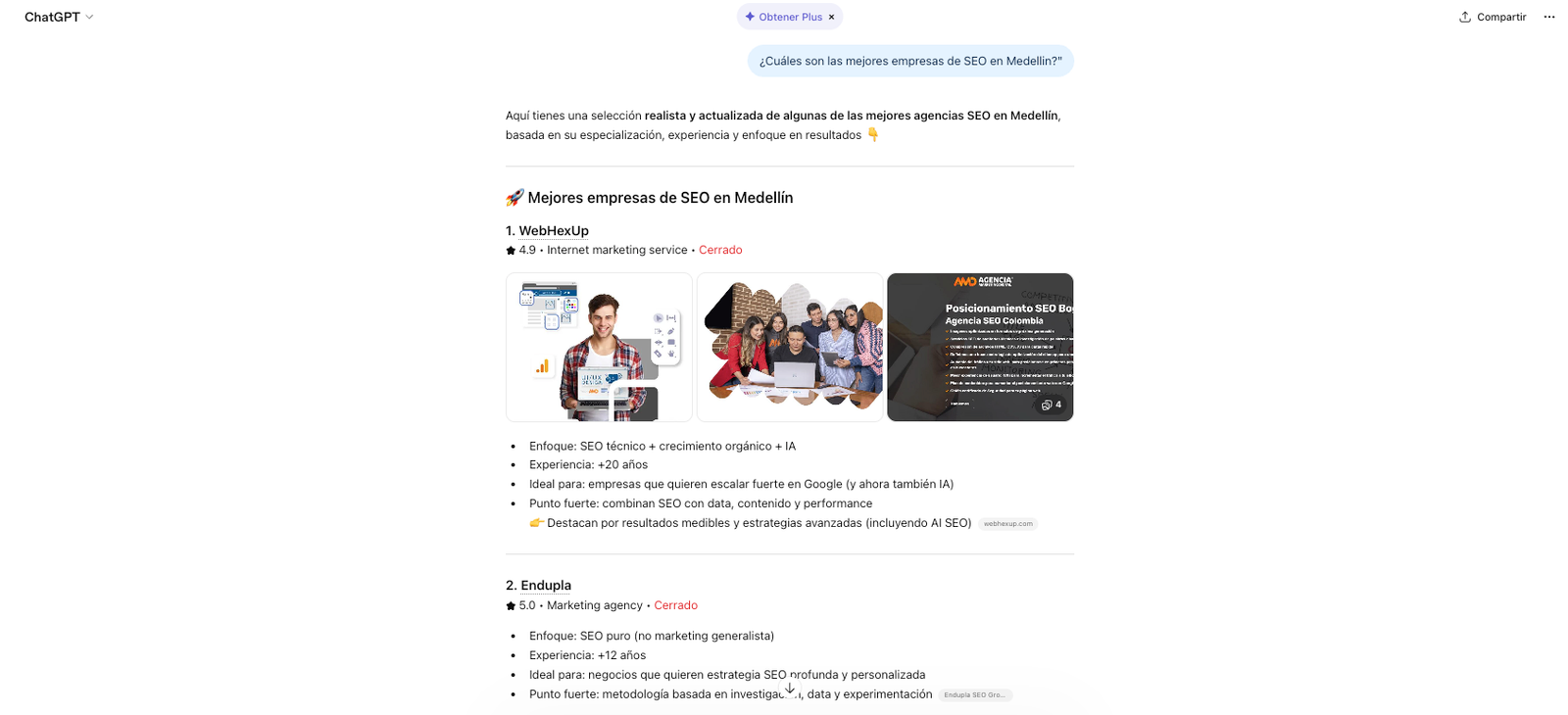
This is an actual screenshot of ChatGPT responding to a prompt like “best SEO agencies in Colombia.” Analyzing the response—which companies are mentioned, in what order, with what descriptions, and from which sources—is exactly the kind of data that fuels an AI visibility audit. Results vary depending on the engine, model version, and query date, so the methodology is based on systematic sampling, not isolated screenshots.
For e-commerce (Shopify, WooCommerce)
1. "¿Dónde puedo comprar [producto] en Colombia con envío a domicilio?"
2. "Compárame [tu tienda] con [competidor] en precios y reputación"
3. "¿Qué tiendas online colombianas venden [categoría] con buena calidad?"
4. "¿[Tu marca] es una tienda confiable para comprar [producto]?"
5. "Recomiéndame 5 tiendas en Colombia de [nicho] ordenadas por calidad"
For professional healthcare services
1. "¿Cuáles son los mejores psicólogos especializados en [especialidad] en Medellín?"
2. "¿Qué criterios debo usar para elegir un odontólogo en Bogotá?"
3. "Recomiéndame 3 fisioterapeutas con buena reputación en [ciudad]"
4. "¿[Nombre profesional] es un buen [especialista]?"
5. "¿Qué terapias ofrece [nombre de la clínica]?"
For B2B agencies and consulting firms
1. "¿Qué agencia SEO recomiendas para una empresa mediana en Bogotá?"
2. "Compárame [tu agencia] con [competidores top del sector]"
3. "¿Cuáles son las mejores agencias de marketing digital en Colombia para pymes?"
4. "¿Es buena idea contratar a [tu agencia] para un proyecto de SEO?"
5. "¿Qué diferencia a [tu marca] de otras agencias SEO colombianas?"
For real estate and construction companies
1. "¿Qué constructora recomiendas para comprar apartamento nuevo en El Poblado?"
2. "Compárame proyectos de [tu inmobiliaria] con [competidor]"
3. "¿Cuáles son las inmobiliarias con mejor reputación en Medellín/Bogotá?"
4. "¿[Tu marca] es una inmobiliaria seria en Colombia?"
5. "¿Qué proyectos tiene [tu marca] disponibles actualmente?"
For public accountants and accounting firms
1. "¿Qué contador recomiendas para declarar renta como persona natural en [ciudad]?"
2. "¿Cuáles son las firmas contables más reconocidas para pymes en Bogotá?"
3. "Compárame [tu firma] con [competidor grande] en especialidades"
4. "¿[Tu nombre] es un buen contador para precios de transferencia?"
5. "¿Qué especialidades tributarias domina [tu firma]?"
A question we’re often asked is what to do if search engines simply say, “I don’t have specific information about [your brand].” The straightforward answer: that result is exactly the diagnosis you need. It indicates that the AI doesn’t have enough signals about your brand to describe or compare it. The action plan following that diagnosis is to systematically build those signals over the next 3–6 months.
The 4 dimensions evaluated by
a professional audit.
The result of the prompts alone is not the analysis—it’s the raw data. A professional analysis organizes that data into four dimensions that answer specific business questions.
Measures what percentage of the prompts in your industry include a mention of your brand. For young companies or those with low digital authority, it’s common for presence to be 0–5%—search engines simply don’t have enough signals to mention you. For established companies with years of solid SEO, it can range from 15–40%. For category leaders in mature markets, it can reach 60–80%. The primary goal of GEO optimization is to increase presence from 0–5% to 15–25% within 6–12 months.
Measures the sentiment and accuracy of mentions. A search engine may mention you but describe you incorrectly (services you don’t offer, wrong location, specialty you don’t practice). These incorrect descriptions are what we in the industry call “AI hallucinations about your brand,” and they pose a real reputational risk. Quality is measured on three levels: factual accuracy (is the information correct?), sentiment (positive, neutral, negative?), and depth (does it know enough, or does it only mention things superficially?).
This measures what percentage of mentions in competitive prompts are about you versus your direct competitors. If, out of 20 competitive prompts, your competitors appear in 70% and you appear in 10%, you have a competitive deficit of 60 points. This metric is more actionable than absolute presence because it tells you specifically how much ground you need to make up and against whom, specifically, you’re losing visibility.
Measure which domains are referenced when search engines generate results about you or your industry. If search engines cite specialized media outlets, industry directories, or authoritative blogs—and you aren’t mentioned there—you know exactly where you need to focus your efforts to gain AI presence. This dimension connects directly to traditional off-page SEO—the same authority signals that Google uses are also used by language models.
From diagnosis to action plan
: what to do next.
An audit without an action plan is just a pretty report. The real value of the audit emerges when it becomes actionable work with clear milestones. These are the typical actions we prioritize based on the findings, ranked by impact in the first 12 weeks after the audit.
First 4 Weeks — Technical Foundation of the Site
Implementation or correction of schema markup (Organization with complete information, Service for each service, FAQPage for frequently asked questions, Person for authors), creation of the llms.txt file in the domain root to guide AI crawlers on which content to prioritize, optimization of the “About Us” page with verifiable credentials and authority data, and review of meta information and heading structure on pillar pages. This work is similar to what we described in the SEO guide for Shopify in Colombia, with adaptations based on the platform.
Weeks 5–8 — Citable Content
Create or rewrite content that directly answers questions in your industry using a citable structure: direct answers within the first 40–60 words of each section, lists and tables where they add value, an FAQ page with 7–12 truly frequently asked questions, and citations to official sources where applicable. Language models prefer content that reads like a good Wikipedia answer—concise, structured, and sourced.
Weeks 9–12 — External Authority
Build relationships with specialized media outlets in your industry (the ones you identified as primary sources in the audit), collaborate with niche blogs or podcasts, establish a presence in specific vertical directories, and optimize external profiles (corporate LinkedIn, Google Business Profile, industry directories). This phase involves slow-moving work but yields high compound impact over time.
Month 4 and beyond — Monitoring and Adjustment
Periodically repeat the audit (every 8–12 weeks) to measure progress, adjust the strategy based on what’s working, expand to secondary search engines if the project requires it, and continue producing content. Visibility in AI is a compound asset: every citable piece of content you publish, every authoritative link you earn, and every mention in a relevant source adds to the total stock of signals that the models use to describe you.
AI visibility by market:
Colombia and Latin America.
📍 Colombia · Domestic market
In Colombia, the adoption of conversational AI accelerated significantly in 2025–2026. ChatGPT has high penetration among urban professionals, Perplexity is growing among technical users, and Gemini is integrated into the Google ecosystem that dominates the country. The competitive window for AI visibility remains open: most medium-sized Colombian companies are not optimized, and search engines have not yet established clear signals for many local brands. A company that consistently builds AI visibility in 2026 can establish itself as a cited benchmark before the market becomes saturated.
📍 Medellín / Bogotá · Tech and B2B companies
Tech companies, B2B startups, and consulting firms in Medellín and Bogotá are the early adopters of AI visibility strategies in Colombia. The pattern is consistent: companies with a strong existing SEO foundation can translate that authority into AI citations within 3–6 months with relatively little technical effort. Companies without a solid SEO foundation need to work on both areas simultaneously. Our SEO agency in Medellín and Bogotá integrates both disciplines.
📍 Latin America · Adjacent Markets
For Colombian companies expanding regionally (Mexico, Peru, Chile, Ecuador, Argentina), AI visibility offers specific advantages: AI models don’t always accurately identify the country of origin for a Latin American company, and a brand with strong AI citations may appear in prompts from neighboring countries. This is especially valuable for SaaS, international professional services, and cross-border e-commerce. We provide SEO services in Colombia with a regional focus for companies seeking such expansion.
Frequently asked questions about
AI visibility audits.
Can I conduct the AI visibility audit on my own?
In principle, yes—you can try the diagnostic prompts we share in this article and see how your brand appears in ChatGPT, Perplexity, and Gemini. That gives you a useful initial snapshot. A professional audit involving 60–120 structured prompts, source architecture analysis, a technical site diagnosis, and a 90-day action plan requires tools, time, and technical expertise that generally make it worthwhile to hire professional support. The cost of doing it poorly or superficially can exceed that of the professional service.
How long does a complete professional audit take?
At Webhexup, a full audit takes between 8 and 12 business days, from the initial strategic mapping to the delivery of the final report with an action plan. Small companies with a limited service portfolio may fall on the lower end of this range. Medium-sized companies with multiple service lines and a presence in several countries fall on the higher end. The process cannot be expedited without compromising methodological quality.
Does the audit guarantee that the company will appear in ChatGPT afterward?
No, and no reputable agency can guarantee that. Language models are constantly changing—ChatGPT periodically updates its knowledge, Perplexity modifies its retrieval algorithm, and Gemini regularly integrates changes from Google. What a well-conducted audit does guarantee is: an accurate assessment of your current situation, a specific action plan based on the findings, a measurement system to track your progress, and technical work that systematically increases your chances of being cited.
Do AEO and GEO replace traditional SEO?
They don’t replace it—they complement it. Traditional SEO remains the technical foundation upon which AEO and GEO are built. A site without good technical SEO, without domain authority, and without a clear semantic structure is unlikely to be cited by language models. The right strategy is solid technical SEO + content optimized for answers + external authority building. AI-powered search engines use signals similar to Google’s, with greater sensitivity to semantic structure and the citability of content.
How often should I repeat the audit?
We recommend rerunning the audit every 8–12 weeks during the first 6 months of active work, and then every 3–4 months in maintenance mode. The AI ecosystem moves fast: search engines change, new models enter the market, and your competitors also begin working on their visibility. Continuous monitoring allows you to adjust your strategy before competitors gain a sustainable foothold.
Which sectors benefit most from AI optimization?
The sectors with the highest return on AI visibility are: professional services (legal, accounting, consulting), health and wellness (with specific ethical considerations by vertical), technology and SaaS, education and courses, niche e-commerce, and technical B2B. The most challenging sectors are commoditized markets where price drives the decision, and simple local transactional markets where users search for “near me” rather than recommendations. In general, if your customers research before buying, AI visibility provides significant benefits.
How much does the audit and optimization service cost on Webhexup?
The service consists of two components: the audit as a one-time deliverable completed within 8–12 days, and the monthly implementation work that follows. Comprehensive plans are tailored to the project’s size, industry, and specific objectives. You can view general price ranges on our pricing page or schedule a diagnostic call where we’ll evaluate your specific situation and provide a concrete proposal.

