
In 2026, when someone in Colombia searches for “What is the best cosmetic medicine clinic in Medellín?” they won’t just look at Google—they’ll ask ChatGPT, Perplexity, and Gemini. And if your site isn’t optimized to be cited by those models, you simply don’t exist for that customer—even if you have the best traditional SEO in the world.
ChatGPT has 800 million daily active users (OpenAI). Perplexity processed 780 million queries in May 2025. Google AI Overviews appear in 48% of searches. Your customers are already searching with AI—the question is whether they find you.
Traditional SEO optimizes for ranking in a list of links. SEO for AI optimizes to be the source that the model cites in its response. They are complementary, not mutually exclusive—but they require specific additional work.
Less than 5% of Colombian websites have AEO structure implemented correctly. The window for a competitive advantage for early adopters is 12–18 months before this becomes widespread.
With nearly 20 years in SEO, I’ve seen how every major shift in search created a window of opportunity for those who adapted first. The shift from PageRank to Penguin, from exact keywords to semantic search, from desktop to mobile-first. Each time, businesses that acted before the change became widespread gained advantages that took their competitors years to achieve. AI SEO is that change right now.
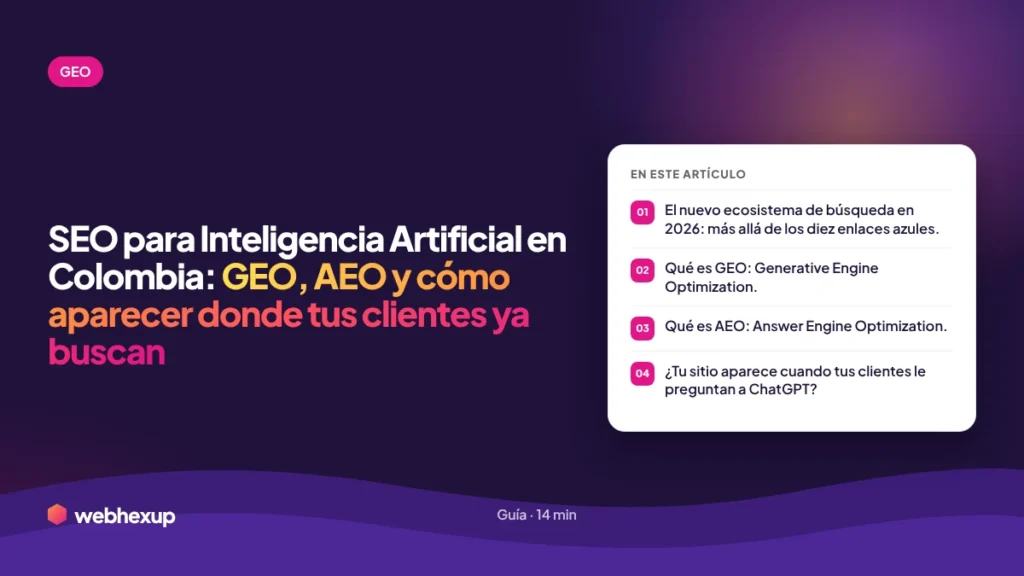
This guide explains exactly what GEO and AEO are, why they differ from traditional SEO, how generative engines select their sources, and what we’ve implemented at Webhexup to rank Colombian websites in the new AI-powered search ecosystem.
The new search ecosystem in 2026:
beyond the ten blue links.
For 25 years, online search worked the same way: the user types a query, Google returns ten blue links, and the user clicks on one. That model is being replaced by a completely different one: the user types or speaks a query, a language model synthesizes information from multiple sources and delivers a direct answer, occasionally citing the original sources.
This change isn’t in the future—it’s happening now. In 2026, a potential client in Bogotá searching for “what is the best SEO service in Colombia” can perform that search on Google (where an AI Overview will appear before the organic results), on ChatGPT, on Perplexity, on Gemini, or on Microsoft’s search engine with Copilot. On each of these platforms, the way your site appears—or doesn’t appear—as a source is different and requires specific optimization.
Google AI Overviews
An AI-generated text block that appears before the #1 organic result. Active in 48% of searches. Requires AEO + E-E-A-T + a solid technical SEO foundation. Cites sources with links.
ChatGPT Search
800 million daily active users. When a user triggers a web search, ChatGPT crawls sources in real time. It favors sites with subject matter authority and structured content.
Perplexity
780M queries in May 2025. Native response engine—always cites sources. Widely used in technical and professional searches. Prioritizes fresh, well-structured content with verifiable data.
Gemini (Google)
Google’s AI model integrated into Search, Gmail, and Workspace. Deeply integrated with Google’s E-E-A-T quality systems. What ranks well on Google tends to appear in Gemini.
The question every business in Colombia should be asking itself today: When a potential customer asks ChatGPT or Perplexity about my industry, do I appear as a source? You can check this in seconds: open ChatGPT and type “What is the best [your service] in [your city]?” If you don’t appear, there’s work to be done.
What is GEO:
Generative Engine Optimization.
GEO (Generative Engine Optimization) is the discipline of building entity authority and digital presence so that large language models (LLMs) know you, recognize you as a relevant source, and cite you in their responses. It’s the long-term vision of SEO for AI.
LLMs learn about the world through their training—millions of texts, documents, articles, and web pages. If your brand, your company, or your name is consistently mentioned in high-quality sources—industry media, authoritative directories, third-party articles—the model learns that you exist and that you’re a relevant entity in your field. If you don’t appear anywhere outside your own site, you practically don’t exist to the LLM.
- Entity Authority: Your brand as a well-known and verifiable entity on the web—Wikipedia (if applicable), Wikidata, verified LinkedIn profiles, Crunchbase, industry directories
- Mentions in external sources: appearances in relevant media, industry publications, podcasts, interviews—any content that names you as a source
- Information consistency: the same name, description, and details across all external profiles—NAP for local businesses, company data for B2B
- Citable proprietary data: studies, statistics, original use cases that other sites might want to cite — content that generates backlinks also generates citations in LLMs
- Presence on review platforms: G2, Clutch, Trustpilot, Google Business Profile — the platforms that LLMs crawl to validate business reputation
What is AEO:
Answer Engine Optimization.
AEO (Answer Engine Optimization) is the practice of structuring content so that answer engines can extract, process, and directly cite it in their responses. While GEO builds long-term reputation, AEO focuses on the structure of each piece of content to make it immediately extractable.
The core principle of AEO: AI models don’t read your pages the way a human does. They process blocks of text in search of question-answer pairs, verifiable data, clear definitions, and hierarchical structures. If your content is written in long paragraphs, without descriptive headings, without sourced data, and without a direct answer at the beginning—the model will struggle to extract anything useful from it. According to Google’s Search Quality Rater Guidelines, the same quality systems that evaluate organic rankings also power the AI Overviews.
- Direct answer within the first 100 words: 44.2% of citations in LLMs come from the first 30% of the text (Seer Interactive). The most important answer comes first
- H2/H3 headings in question format: “What is GEO?” instead of “Definition of GEO.” The models look for explicit question-answer pairs
- Short paragraphs of 2–4 sentences: extractable blocks without losing semantic context
- LLM Summary block at the beginning: a 3–5-sentence summary of the full article, written in the language an LLM would use to cite you
- Data with cited sources: verifiable statements are more citable than unsupported opinions
- FAQs with 40–80-word answers: the format that most directly feeds into generative models’ responses
GEO vs. AEO vs. Traditional SEO:
What Each Does and When to Use Each.
| Scope | Traditional SEO | AEO | GEO |
|---|---|---|---|
| Objective | Rank on Google’s search results page | To be cited as a source in AI responses | To be recognized as an entity by LLMs |
| Where does it operate? | Technical structure, keywords, backlinks | Content structure of each page | External presence, mentions, reputation |
| Time to see results | 3–6 months | 30–45 days for initial results | 6–12 months of ongoing development |
| Key metric | SERP ranking, organic traffic | Citation rate in AI Overviews and LLMs | Share of Voice in AI responses |
| Are they mutually exclusive? | No—they are complementary and reinforce each other | ||
| Required foundation | The foundation of everything | Requires a solid technical SEO foundation | Requires AEO + E-E-A-T to be implemented |
| Priority in Colombia by 2026 | Always necessary | High — window of opportunity open | Medium-high — long-term development |
The correct way to view them is not as alternative options but as stacked layers: technical SEO is the foundation without which nothing works; AEO is the content layer that makes what already ranks extractable; and GEO is the external reputation layer that tells the models the source is trustworthy. Removing any of the three layers weakens the other two.
No SEO for AI — What’s Happening Today
- Your site was ranking well on Google, but impressions are rising and clicks are falling
- A customer asks ChatGPT about your industry—it mentions your competitors, not you
- You appear in position #2 on Google, but the AI Overview cites #5
- Your informational articles are losing traffic even though they maintain their rankings
With SEO for AI — what you achieve
- Your site is cited in AI Overviews for key searches in your industry
- ChatGPT and Perplexity mention you when users ask about your specialty
- +35% more organic clicks and +91% more paid clicks when cited in AIO (Seer Interactive, 25.1M impressions)
- Brand recognition that drives month-over-month growth in branded search
How ChatGPT, Perplexity, and Gemini select their sources
.
Each generative model has its own logic for selecting sources. Understanding the differences helps you prioritize where to focus your efforts based on your customers’ profiles:
ChatGPT (OpenAI)
In its web search mode (ChatGPT Search), it crawls sources in real time, similar to a search engine. It prioritizes sites with high domain authority, structured content with direct answers, and cited sources. The model’s base training favors sites that appeared frequently in high-quality data up to its cutoff date—which is updated periodically. To appear in responses without an active web search, you need entity authority built up during training.
Key takeaway for Colombia: ChatGPT has high penetration among professionals and businesses. It’s the channel where B2B search is growing the fastest.
Perplexity
A native answer engine that always cites sources—it’s part of its value proposition. It crawls the web in real time for each query. It favors fresh content (recently published or updated) with verifiable data and good structure. Sites with correct Schema Markup have better data extraction. Perplexity is especially relevant for technical, scientific, and professional searches—exactly the profile of many Colombian B2B clients.
Key for Colombia: Perplexity is seeing growing adoption in the academic, tech, and consulting sectors—high-revenue B2B sectors.
Gemini (Google)
As Google’s AI model, Gemini uses the same E-E-A-T quality systems as organic ranking. Content that Google already ranks highly is very likely to appear in Gemini. The difference: Gemini also considers the domain’s semantic authority on the specific topic of the query. A site with 20 high-quality articles on SEO is more likely to be cited in SEO-related queries than a general-interest site with just one good article on the topic.
Key point for Colombia: Gemini is integrated into the Google ecosystem that most Colombians already use—Gmail, Drive, Search. It’s the search engine with the widest reach.
How we implement AI
SEO at Webhexup: the exact process.
When a client hires our AI SEO service, we follow a structured four-phase process. There are no shortcuts or magic solutions—it’s systematic technical and editorial work:
AI Visibility Audit
We manually test 15–20 key searches related to the client’s industry on ChatGPT, Perplexity, Gemini, and Google AI Overviews. We map out which sites appear as sources, what type of content they cite, and where the client falls short compared to their competitors.
AEO Technical and Structural Audit
We review the technical SEO foundation (speed, indexing, Schema), the structure of existing articles (do they provide a direct answer at the beginning? Do they include FAQs? Do they have an LLM summary?), and the site’s verifiable E-E-A-T signals.
AEO Implementation in Existing Content
We rewrite priority articles to add: LLM summaries, question-format headings, extractable paragraphs, FAQs with microdata, and data with cited sources. We don’t delete what works—we improve it so it works with AI, too.
GEO — Building Entity Authority
We identify external platforms where the client should have a verified presence (industry directories, review platforms, specialized publications) and execute a strategy to build relevant mentions on a monthly basis.
Monitoring is done monthly: we manually verify key searches on each generative search engine and measure whether the client has started appearing as a source. The first results are typically seen within 30–60 days for AEO (long-tail citations in AI Overviews) and within 4–6 months for GEO (appearance in ChatGPT and Perplexity responses without an active web search).
Why the Colombian
market has a window of opportunity right now.
There’s a reality I see in every audit I conduct in Colombia: less than 5% of websites have AEO structure implemented correctly. No FAQs with microdata, no LLM summaries, no question-format headings, and no data with sources. Most have basic technical SEO and well-written content—but written for humans, not for AI models.
This creates a 12- to 18-month window of competitive advantage for Colombian businesses that act now. When AI SEO becomes widespread—just as mobile SEO or speed SEO did—the barrier to entry rises and the cost of catching up multiplies. The opportunity is to act before everyone else does.
🔴 High Urgency
- Clinics and Healthcare Professionals
- Lawyers and law firms
- Universities and colleges
- Accountants and consultants
- Marketing agencies
🟡 Medium urgency
- Hotels and tourism
- Real estate agencies
- Consultants and coaches
- Premium restaurants
- Software and technology
🟢 Less urgent
- E-commerce for physical products
- Transactional retail
- Direct B2B manufacturing
- Wholesale distribution
Frequently Asked Questions About
AI SEO in Colombia.
Does AI SEO replace traditional SEO?
No—they are complementary. 92% of citations in AI Overviews come from domains that are already in the organic top 10. Without a solid technical SEO foundation, GEO and AEO have very little effect. The correct sequence: first technical SEO, then AEO in the content, then GEO for external authority. Not the other way around.
How long does it take to see results from AI SEO?
The first AEO results (mentions in AI Overviews for specific long-tail searches) appear within 30–45 days of proper implementation. Appearing consistently in ChatGPT and Perplexity without an active web search—which depends on GEO—is a 4–6-month process of continuous development. There is no shortcut to speed up LLM training.
Are Google’s AI Overviews active in Colombia?
Yes. From my own Search Console and those of my clients, I see an unmistakable pattern: impressions are rising, but clicks are falling for informational searches. The rollout in Spanish-speaking markets is active and accelerating. Sectors such as healthcare (88% adoption), education (83%), and professional services are the most affected, according to BrightEdge data tracked by ALM Corp.
Can AI-generated content appear in generative search engines?
Technically, yes, if it meets quality criteria. But there’s a paradox: LLMs prioritize signals of real-world experience—firsthand data, personal perspectives, and real-life examples. Content generated purely by AI without human editing has fewer signals of real-world experience and is therefore less likely to be cited. AI-assisted content with extensive human editing and verifiable first-hand data performs well.
What is an llms.txt file, and should I have one?
The llms.txt is an emerging standard file (similar to robots.txt) that allows site owners to provide structured information specifically for language models—indicating what content they can crawl and cite, in what context, and with what attribution. As of 2026, its adoption is still limited but growing. For most Colombian businesses, implementing AEO and GEO has a greater immediate impact than creating an llms.txt—but it’s a step we include in advanced projects.
How much does Webhexup’s AI SEO service cost?
The AI SEO service is part of our comprehensive SEO plans. The cost depends on the size of the website, the industry, and the level of competition. To get an exact quote for your business, schedule a free diagnostic call—we’ll analyze your current situation before providing a quote. You can view general price ranges on our pricing page.
AI SEO in the Colombian market:
context by city.
📍 Medellín
In Medellín, sectors such as cosmetic medicine, technology, tourism, and digital marketing are already seeing competitors mentioned in AI Overviews and Perplexity. Businesses in El Poblado, Laureles, and El Centro that haven’t implemented AEO are losing visibility in high-intent searches. At Webhexup in Medellín, we provide AI-driven SEO with firsthand knowledge of the local market.
📍 Bogotá
Bogotá is home to the sectors most exposed to generative AI: law firms, financial consulting, higher education, and technology. Bogotá-based companies that take the lead in GEO and AEO will solidify their positions in AI search engines—positions their competitors will take months to reach. Our Bogotá SEO agency specializes in these sectors.
📍 Cali · Barranquilla · Mid-sized Cities
In mid-sized cities, SEO competition for AI is virtually nonexistent. A business that implements GEO and AEO in Bucaramanga, Pereira, or Manizales today can establish a position of authority in generative search engines that would take competitors years to achieve. The window of opportunity is greater here than in major cities. We handle projects nationwide from our SEO agency in Colombia.